Grotte de Sainte-Colombe
Origin of the name Grotte de Sainte-Colombe
The cave bears the name of Saint Colombe, to whom it is dedicated and who, according to tradition, stayed there. Auguste Quiquerez called it « Baume de Ste-Colombe » in 1871. It is not known why it was dedicated to her: the life of Saint Colombe, a martyr at Sens, hardly fits a stay in the Jura.[1][3][4]
Founding of Grotte de Sainte-Colombe
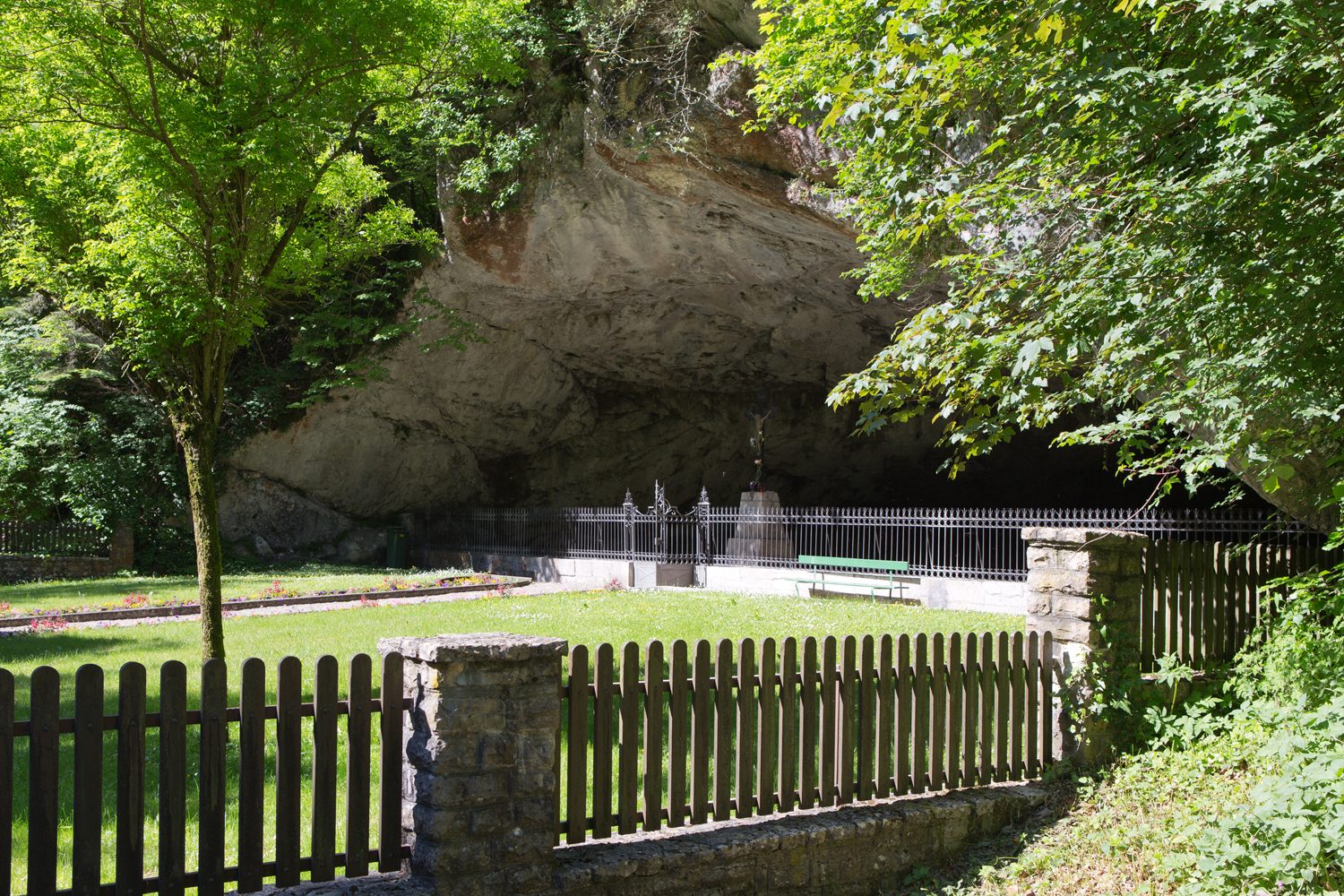
The cave is a natural karst cavity, a single chamber about 30 m long, 26 m wide and 7 m high, at 531 m above sea level, entered through a vast portal. People first used it as a rock shelter, mainly in the Middle Bronze Age. It then became a Christian place of worship, mentioned in church documents from the 13th century. This cult probably derives from the Christianisation of an old pagan place of worship devoted to water. The pilgrimage was laid out at the end of the 18th century. The cave opens on the left bank of the Sorne, in the gorges north of Undervelier, between the village and the hamlet of Les Forges, beside the road linking the Delémont basin with Bellelay through the Pichoux gorge. The former municipality of Undervelier has been part of Haute-Sorne since 1 January 2013.[1][2][3][4]
History of Grotte de Sainte-Colombe
Neolithic. Bones and worked flints show a human presence in the Stone Age.[3][4]
Middle Bronze Age. Main occupation of the cave, used as a rock shelter. Late Bronze Age pottery has also been found there.[1][2][4]
Roman period and late Middle Ages. Secondary occupation of the cave (Gallo-Roman pottery).[1]
13th century. The Christian pilgrimage site is mentioned in church documents.[1]
1782-1794. The Prince-Bishop of Basel François-Joseph Sigismond de Roggenbach encourages the fitting out of the cave as a place of pilgrimage.[2][3][4]
1868. Auguste Quiquerez makes a small test dig: ash, charcoal, sherds he attributes to the Stone Age and split bones, material since lost.[1]
1871. Quiquerez publishes « La Baume de Ste-Colombe » in the Musée neuchâtelois.[1]
around 1900. The cave takes on its present appearance.[3][4]
1933. The parish restores the annual pilgrimage of the « bonne fontaine ».[3]
1942. The ADIJ resumes research: L. Lièvre directs trenches under the scientific supervision of Frédéric-Édouard Koby. The deposits, disturbed by earlier works and by water, yield about a hundred sherds, iron objects and many bones.[1]
1943. Koby and Lièvre publish « Les cavernes du Jura : Ste-Colombe ».[1]
1994. M. Schenardi studies the Bronze Age material and concludes that the cave was occupied around the middle of the Middle Bronze Age.[1]
Historic sites in Grotte de Sainte-Colombe
Cave chapel. Place of worship set up in the cave's large chamber, behind a vast portal, with a cross at the entrance. A pilgrimage is held there every 15 August. Access is free of charge.[1][3][4]
Remains in Grotte de Sainte-Colombe
Archaeological finds. The excavations yielded mainly Middle and Late Bronze Age pottery (about 1500 to 1000 BC), as well as worked flints, animal bones (beaver, elk, ibex), iron objects and Gallo-Roman and medieval pottery. The collections are kept at the Musée jurassien des sciences naturelles in Porrentruy.[1][4]
Legends of Grotte de Sainte-Colombe
Saint Colombe and the bear. According to legend, Saint Colombe, a young Spanish princess who had taken refuge in the Jura mountains, stayed in the cave, where she came to fetch water under the protection of a bear. A local tradition also says she stayed in a cave of the same name at Frenois, above Soulce.[3][4]
The « bonne fontaine ». The water dripping at the foot of a stalagmite is considered beneficial: the sick come to seek healing and mothers bring their sickly children. Local traditions tell of children healed at the spring, near the cross at the entrance.[1][4]
Sources
- Office de la culture du Jura, Section d'archéologie et paléontologie, « Undervelier, grotte Sainte-Colombe »
- Dictionnaire historique de la Suisse, « Undervelier »
- Inventaire fédéral des sites construits (ISOS), « Cluses d'Undervelier »
- Showcaves.com, « Grotte église de Sainte-Colombe »
- Office fédéral de topographie swisstopo, map.geo.admin.ch
Other villages near Grotte de Sainte-Colombe
Missing information, or do you have a source? Suggest a correction or addition. Every submission is checked before it's published.
Suggest a change