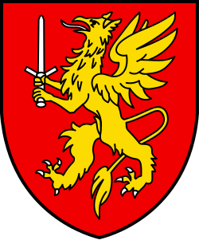
Leuk
Origin of the name Leuk
The place appears in 515 as « villa de Leuca ». In French it is called Loèche. The name remains unexplained.[1]
Founding of Leuk
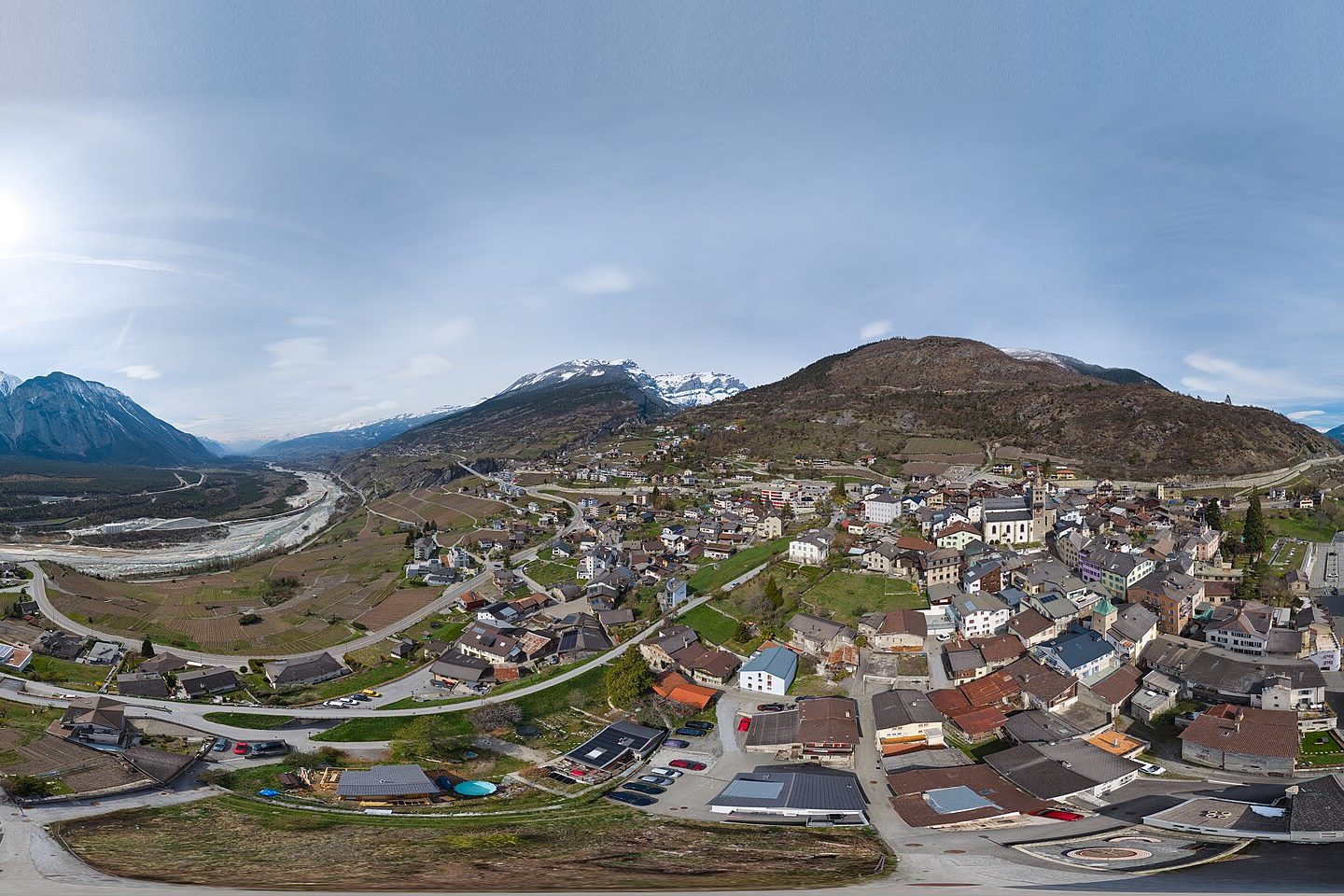
La Tène graves show that the slope on the right bank of the Rhône, between the Dala gorge and the Feschelbach, was inhabited before Roman times. In the 6th century the place was part of the royal estate of the Burgundian king Sigismund, who gave it to the Abbey of Saint-Maurice. A church already stood there in the 6th-7th centuries. Alemannic immigrants gradually Germanised the Celto-Romance population, though a strong Romance minority still existed in the 14th century. Once it passed to the bishop of Sion, Leuk received from him its own measure, a hospital and a sust, a goods warehouse on the trade route between northern Italy and the Champagne fairs. The bishop's vidame and mayor built the bishop's castle and the vidame's tower. In the 14th century the community consisted of three thirds. As episcopal power declined, new leading families turned the market town into a self-confident small town with substantial burgher houses. The municipality today includes Leuk-Stadt, Susten (La Souste) on the valley floor, the left-bank hamlets (Brianen, Feithieren, Gampinen, Pfyn) and Erschmatt. Who founded Leuk is not known.[1]
History of Leuk
La Tène period. Graves containing pins, fibulae and belt hooks show settlement before Roman times.[1]
515. First mention as « villa de Leuca ».[1]
6th century. Leuk belongs to the royal estate of the Burgundian king Sigismund, who gives it to the Abbey of Saint-Maurice. A first church is built in the 6th-7th centuries.[1]
around 1000. Alemannic immigrants gradually Germanise the Celto-Romance population.[1]
1138. Leuk passes permanently to the mensa of the bishop of Sion.[1]
1209-1310. The bishop grants Leuk its own measure (1209), a hospital (1285) and a sust on the trade route between northern Italy and Champagne, with regulations for carters (1310).[1]
1227. First mention of the parish, which originally covers the whole dizain of Leuk.[1]
1296. On the Seufzermatte, locals loyal to the bishop defeat the Upper Valais nobility, supported by men from the Bernese Oberland.[1]
1386. By destroying the Dala bridge, the people of Leuk halt the advance of Count Amadeus VII of Savoy into Upper Valais.[1]
1415. During the Raron affair, the country people destroy the bishop's castle and the vidame's tower.[1]
1458. Leuk's customary law is written down. The « alt Burgrecht » is supplemented in 1563.[1]
1494. Bishop Jost von Silenen consecrates the late Gothic parish church of St Stephen, built by Ulrich Ruffiner.[1]
1541. Ulrich Ruffiner builds the town hall on the ruins of the vidame's tower.[1]
1604. The Valais Diet meeting in Visp decides to remain Catholic. Leuk families drawn to the Reformation, such as the Mageran and Ambühl, leave for Bern, but most return to the old faith.[1]
1690-1694. The Ringacker chapel is built on the former plague cemetery.[1]
1799. After the battle of Pfyn against the French, Leuk narrowly escapes being burned.[1]
1915. The Leuk-Leukerbad railway opens; it is replaced by buses in 1967.[1]
1972. Construction begins on the satellite telecommunications earth station.[1]
1999. The Leuk Castle Foundation is created to restore the bishop's castle. Mario Botta tops its tower with a glass dome.[1]
2013. Erschmatt is incorporated into the municipality of Leuk.[1]
Population of Leuk
Sources and references: [1][3]
| 1850 | 1'042 inhabitants |
| 1900 | 1'592 inhabitants |
| 1950 | 2'336 inhabitants |
| 2000 | 3'361 inhabitants (before the incorporation of Erschmatt) |
| 2025 | 4'346 |
Historic sites in Leuk
Bishop's castle. Seat of the bishop's mayor, destroyed in 1415 during the Raron affair. A foundation created in 1999 restores it and holds cultural events there. The architect Mario Botta placed a glass dome on its medieval tower.[1]
Town hall. Late Gothic building erected in 1541 by Ulrich Ruffiner, from Prismell, on the ruins of the vidame's tower destroyed in 1415.[1]
Church of St Stephen and ossuary. Late Gothic church by Ulrich Ruffiner, richly furnished with altars and sculptures, consecrated in 1494. Its massive Romanesque bell tower dates from the earlier churches. The ossuary is decorated with a dance of death.[1]
Ringacker chapel. Built in 1690-1694 on the former plague cemetery, it is one of the most important Baroque spaces in Valais. A hermit lived in the adjoining hermitage from about 1720 to 1885.[1]
Thel pilgrimage chapel. Place of pilgrimage within the municipality.[1]
Susten (La Souste). Village on the valley floor on the left bank, which played an important role in medieval through traffic. No building of the sust survives. To the east stands the former Perrini-von Werra castle, converted into a retirement home.[1]
Leuk earth station. Satellite telecommunications station, begun in 1972. Its large antennas make Leuk a telecommunications centre of international importance.[1]
Remains in Leuk
La Tène graves. Graves containing pins, fibulae and belt hooks, proving settlement before Roman times.[1]
Early medieval churches. Archaeology revealed a 6th-7th century church, perhaps developed from a Roman building, replaced before the 9th century by a larger complex, then by new buildings in the 11th and 12th centuries.[1]
Statues from the ossuary. In 1982, 26 statues from the 13th-16th centuries were discovered under the piled-up bones of the ossuary, including a 14th-century Pietà of exceptional quality.[1]
Natural defences and bridges. The town was protected by the Dala gorge to the west, with a 14th-century tower and bridge, by the Rhône to the south and by the Feschel gorge to the east, with a bridge of 1563.[1]
Sources
- Dictionnaire historique de la Suisse, « Loèche (commune) » (Alois Grichting, version du 04.01.2017)
- Dictionnaire historique de la Suisse (version allemande), « Leuk (Gemeinde) » (Alois Grichting, version du 04.01.2017)
- Office fédéral de la statistique (OFS), STATPOP, chiffres provisoires au 31.12.2025, via citypopulation.de
- geo.admin.ch, recherche de lieux (coordonnées)
Localities of the municipality with a page
Other villages near Leuk
Missing information, or do you have a source? Suggest a correction or addition. Every submission is checked before it's published.
Suggest a change