Pâquis
Origin of the name Pâquis
In 1508 the « Pâquis » are described as pastures. The word is said to have first meant a place where game feeds, then pastures, and to blend « pâtis » (uncultivated land used for grazing) and « pasquier », from the Latin « pascuarium » (pasture).[1][3]
Founding of Pâquis
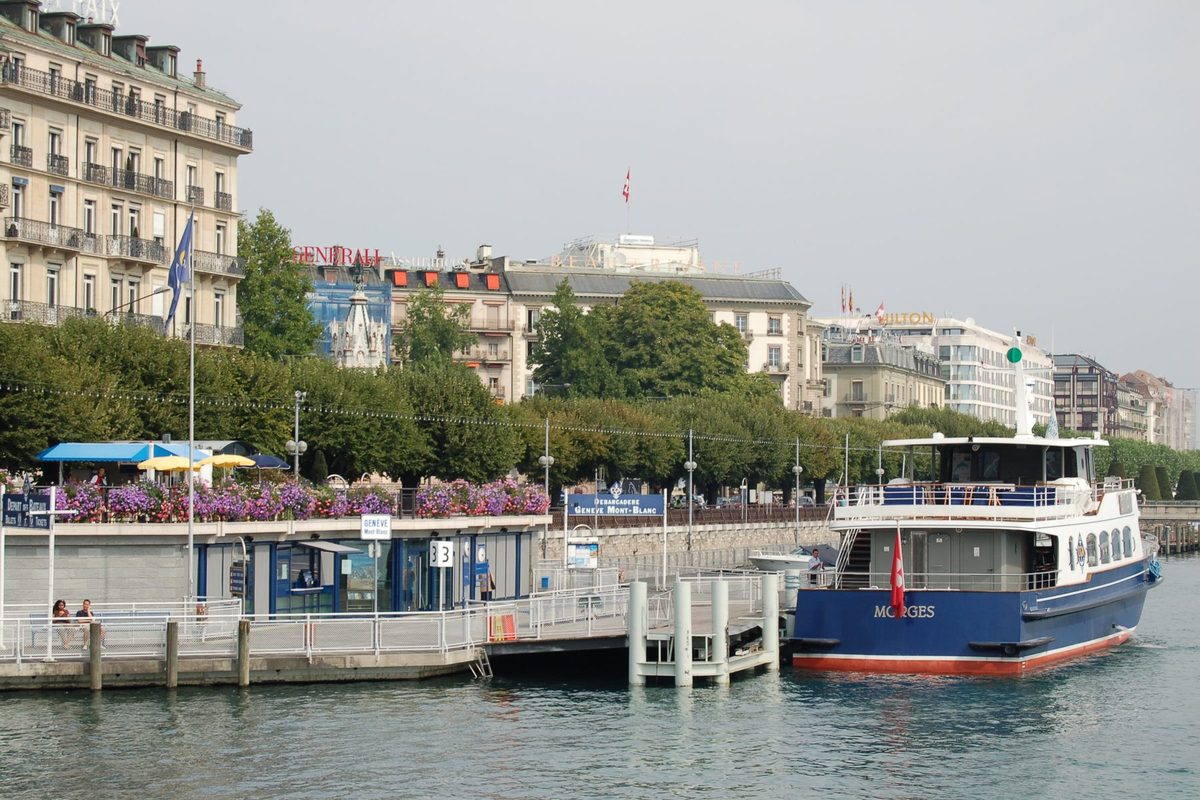
The Pâquis is a district of the municipality of Genève, on the right bank, between the railway station and the lake. It was first an area of pastures outside the city walls, given by Duke Charles III of Savoy to the plague hospital of Plainpalais. A tile works settled here, then the shooting range and harbour of the Société de la Navigation, and finally Genève's first printed-cotton (indiennes) factory. The area belonged to the municipality of Le Petit-Saconnex, created under French rule, until its annexation by Genève. In the 19th century the meadows gave way to houses, luxury hotels and streets laid out at right angles.[1][3]
History of Pâquis
3000-750 BC. Several lakeside settlements occupy the Pâquis, from the Middle Neolithic (3000-2500 BC) to the end of the Bronze Age (around 750 BC).[1]
1458. A tile works is mentioned in the Pâquis.[1]
1508. Duke Charles III of Savoy gives the Pâquis (pastures) to the plague hospital of Plainpalais. The same year the Savoyard protectorate grants an extension of the franchises to the Pâquis.[1][2]
1677. The Société de la Navigation sets up its shooting range and a harbour in the Pâquis.[1]
1710. Opening in the Pâquis of Genève's first printed-cotton (indiennes) factory.[1]
1798. The French create the municipality of Le Petit-Saconnex, which includes the Pâquis.[1]
1825-1849. A suspension bridge links the Pâquis to Saint-Gervais.[1]
1831. Chateaubriand stays on the place de la Navigation. A nearby street and square now bear his name.[3]
1842. Camille Corot paints « Le Quai des Pâquis à Genève », now in the Musée d'art et d'histoire.[3]
1850. Genève annexes the Pâquis, Montbrillant and the Grottes, detached from the municipality of Le Petit-Saconnex.[1]
1872. Opening of the Bains des Pâquis, a private establishment called « Bains Henri » after its owner. They become municipal in 1889.[5]
1898. On 10 September Empress Elisabeth of Austria (Sissi) is stabbed on the quai du Mont-Blanc as she leaves the Hôtel Beau-Rivage.[4]
1911. A lighthouse is erected at the Bains des Pâquis.[5]
1931. The Bains des Pâquis are completely rebuilt.[5]
1988. Threatened with demolition, the Bains des Pâquis are saved by a popular initiative.[5]
Historic sites in Pâquis
Bains des Pâquis. Baths opened in 1872, municipal since 1889, rebuilt in 1931 and saved in 1988 by a popular initiative. A lighthouse was erected there in 1911.[5]
Brunswick Monument. Monument built in 1879 in the Jardin des Alpes for Duke Charles d'Este-Guelph, who died in 1873 and had left his fortune to the city. It imitates a 14th-century tomb in Verona.[5]
Quai du Mont-Blanc. Quay where Empress Elisabeth of Austria was assassinated on 10 September 1898. A statue marks the spot.[4]
Sources
- Dictionnaire historique de la Suisse, « Petit-Saconnex, Le » (Catherine Courtiau)
- Dictionnaire historique de la Suisse, « Genève (commune) » (Martine Piguet, Jean Terrier, Charles Bonnet, Liliane Mottu-Weber, Irène Herrmann, Charles Heimberg)
- Ville de Genève, « Histoire et développement du quartier Pâquis Sécheron »
- Ville de Genève, « Anecdotes du quartier Pâquis Sécheron »
- Ville de Genève, « Curiosités du quartier Pâquis Sécheron »
- Office fédéral de topographie swisstopo, geo.admin.ch, nom local « Pâquis - Centre (GE) - Genève »
Other villages near Pâquis
Missing information, or do you have a source? Suggest a correction or addition. Every submission is checked before it's published.
Suggest a change