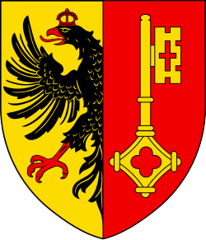
Genève
Origin of the name Genève
Caesar is the first to name the town, in 51 BC: « Genua ». Later come « Genava » and, in the Notitia Galliarum, « Civitas Genavensium ». The origin of the name has not yet been explained.[1]
Founding of Genève
Geneva grew up on a hill protected by the lake, the Rhône, the Arve and, to the east, by ditches. People lived here from the end of the 5th millennium BC: the oldest traces were found beneath the temple of Saint-Gervais. Lakeside villages then occupied the harbour in the 4th millennium and in the Bronze Age. Towards the end of the 2nd century BC, the Allobroges developed an oppidum on the Saint-Pierre hill. Once Rome had subdued them, the town became an outpost of Transalpine Gaul, then a vicus attached to the colony of Vienne, and finally a civitas at the end of the 3rd century. By the 4th century it was already the seat of a bishop.[1][4]
History of Genève
end of the 5th millennium BC. Earliest traces of settlement, discovered beneath the Temple de Saint-Gervais.[1]
121 BC. Subjugation of the Allobroges: Genève becomes an outpost of Transalpine Gaul.[1]
58 BC. Caesar settles in Genève; the town expands and is given ditches and earth walls.[1]
around 376-380. Completion of the first cathedral complex. Isaac is the first known bishop.[1]
443. Settlement of the Burgundians in Sapaudia: Genève becomes their capital.[1]
563. The Tauredunum landslide causes a tidal wave on the lake and destruction in Genève.[1]
1124. The Treaty of Seyssel recognises the bishop's sovereignty over the city. In 1162 Frederick Barbarossa makes the bishops immediate princes of the Empire.[1]
1309. Bishop Aymon de Quart recognises the syndics, four elected each year. Construction of the Molard market hall.[1]
1387. Bishop Adhémar Fabri solemnly confirms the city's franchises, in 79 articles.[1]
1526. Treaty of co-citizenship with Bern and Fribourg, approved on 25 February: end of episcopal power.[1]
1536. The Reformation is adopted by the Conseil général on 21 May.[1]
1559. Founding of the Academy.[1]
1602. On the night of 11 to 12 December (old style), the Escalade: the Savoyard attack led by Charles de Simiane d'Albigny fails. About a hundred dead, seventeen of them from Genève. The Peace of Saint-Julien (1603) implicitly recognises the independence of Genève.[2]
1708. Joseph Abeille's « machine des eaux » pumps water from the Rhône for the city.[1]
1798. Annexation to France: Genève becomes the seat of the Léman department. The law of 17 February 1800 gives it a mairie.[1][4]
1842. After the Restoration of 1814, which had abolished the municipality, and the coup of 21 November 1841, the Constitution of 1842 restores the city's municipal autonomy: a municipal council of 81 members elects an administrative council of 11 members.[1][4]
1849. Demolition of the fortifications begins, opening the city to new districts, the university (1868-1873) and the Grand Théâtre (1874-1879).[1]
1891. Inauguration of the Jet d'eau, for the 600th anniversary of the Confederation.[1]
1920. The League of Nations settles in Genève. The UN has been present there since 1946.[1]
1931. After the popular vote of 18 May 1930, the merger with Plainpalais, Les Eaux-Vives and Le Petit-Saconnex is carried out on 10 July. The four districts bearing the names of the former municipalities remain until 1958.[1][4][5]
1968-1969. Lise Girardin is the first woman mayor of Genève.[1]
Population of Genève
Sources and references: [1][3]
| 1356-1358 | 491 hearths (households), about 2'500 inhabitants |
| 1550 | 13'150 (town at the time) |
| 1650 | 12'250 (town at the time) |
| 1690 | 16'220 (town at the time) |
| 1798 | 24'331 (town at the time) |
| 1834 | 27'177 (town at the time) |
| 1850 | 37'724 (present municipal territory) |
| 1900 | 97'359 (present municipal territory) |
| 1930 | 124'121 (present municipal territory) |
| 1950 | 145'473 |
| 1970 | 173'618 |
| 2000 | 177'964 |
| 2025 | 210'601 |
Historic sites in Genève
Saint-Pierre Cathedral. Begun in the mid-12th century under Bishop Arducius de Faucigny and completed a century later, it marks the shift from Romanesque to Gothic. Cardinal Jean de Brogny had the Maccabees chapel built inside it, one of the early examples of flamboyant Gothic, between 1397 (papal authorisation) and 1405. The original furnishings have almost entirely disappeared. The neoclassical portico, designed by Benedetto Alfieri, dates from 1752-1756 (or 1752-1755). Cultural property of national importance.[1][7][9]
Maison Tavel. The oldest surviving medieval house in Genève, owned from the late 13th century by the noble Tavel family, who rebuilt it after the fire of 1334. A cultural property of national importance, it has housed since 1986 a museum of urban history and daily life, with the Magnin relief, a model of Genève around 1850 made by the architect Auguste Magnin between 1880 and 1896.[8][9]
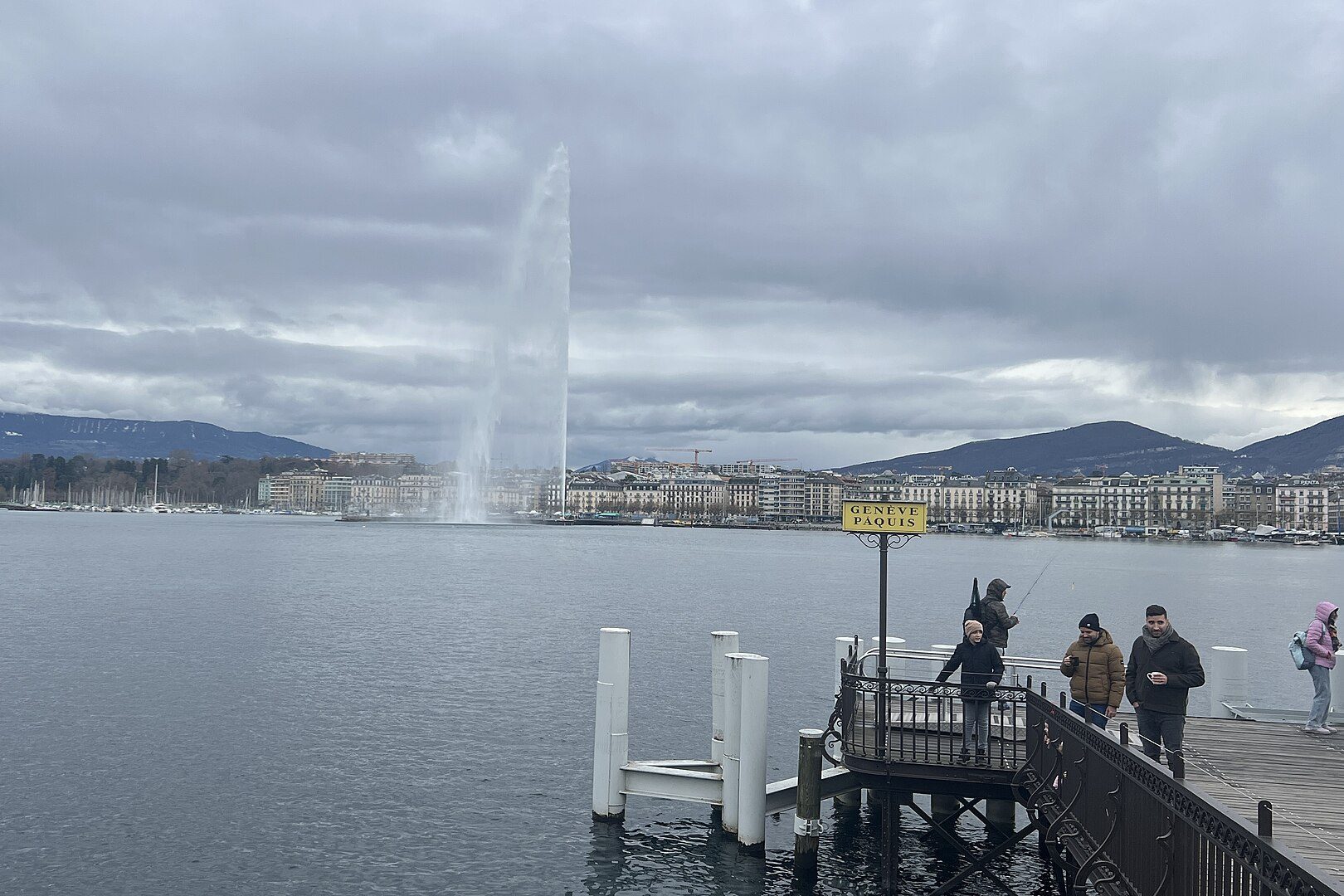
The Rade and the Jet d'eau. The general port or Rade, laid out in 1858, served lake trade until the early 20th century. The Jet d'eau was inaugurated there in 1891.[1]
Musée d'art et d'histoire. Built in 1903-1910 on land freed by the demolition of the fortifications, it holds among other things trophies of the Escalade of 1602.[1][2]
Remains in Genève
Archaeological site of the cathedral. Excavated and laid out between 1976 and 2006 beneath Saint-Pierre Cathedral, it shows the stages of the episcopal group: a first Christian sanctuary set up in a Roman dwelling that has been interpreted as a praetorium, a cathedral complex completed around 376-380, then a second cathedral and a relocated baptistery in the 5th century.[1][7]
Gallic port. Oak piles dated by dendrochronology show that a port was laid out around 123-105 BC at the foot of the oppidum.[1]
Lakeside settlements of the harbour. Lakeside villages occupied the harbour area in the 4th millennium BC and densely in the 11th-10th centuries BC (Late Bronze Age), before being abandoned in the 9th century BC after a rise in the lake level.[1]
Legends of Genève
Mère Royaume. According to the Escalade tradition, Mère Royaume threw projectiles at the Savoyard attackers on the night of 1602. She remains an emblematic figure of the Escalade festivities, along with the song « Cé qu'è lainô », composed shortly after the event and now the anthem of Genève.[2]
Sources
- Dictionnaire historique de la Suisse, « Genève (commune) » (Martine Piguet, Jean Terrier, Charles Bonnet, Liliane Mottu-Weber, Irène Herrmann, Charles Heimberg), version du 07.02.2018
- Dictionnaire historique de la Suisse, « Escalade », version du 26.11.2009
- Office cantonal de la statistique (OCSTAT), Mémento statistique du canton de Genève 2026, tableau Population résidante par commune, en 2025
- Ville de Genève, « Le régime municipal »
- Ville de Genève, Compte rendu de l'administration municipale pendant l'année 1931 (1932)
- geo.admin.ch, service de recherche de swisstopo (coordonnées)
- Inventaire fédéral des biens culturels (PBC), fiche 2443 « Cathédrale Saint-Pierre et chapelle des Macchabées », texte de la Société d'histoire de l'art en Suisse (Guide artistique de la Suisse)
- Inventaire fédéral des biens culturels (PBC), fiche 2466 « Maison Tavel », texte de la Société d'histoire de l'art en Suisse (Guide artistique de la Suisse)
- Inventaire PBC, liste cantonale Genève (état au 1.1.2026)
Localities of the municipality with a page
- Bourg-de-Four
- Champel
- Faubourgs de Saint-Léger et Saint-Victor
- Le Petit-Saconnex
- Les Acacias
- Les Eaux-Vives
- Pâquis
- Plainpalais
- Prieuré de Saint-Jean
- Saint-Gervais
Other villages near Genève
Missing information, or do you have a source? Suggest a correction or addition. Every submission is checked before it's published.
Suggest a change