Pierre-aux-Dames
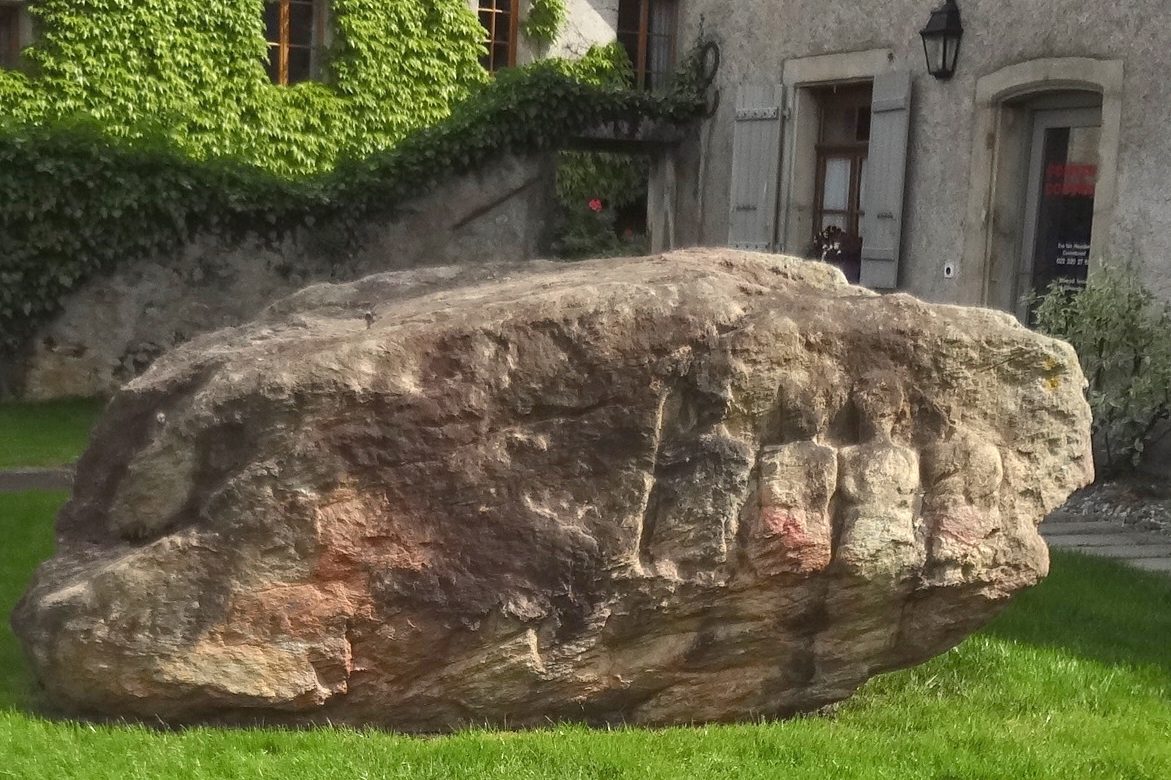
Origin of the name Pierre-aux-Dames
The block owes its name to the four female figures carved on it. They have been identified as « matres » or « matronae », deities of Celtic origin linked to fertility and sometimes to funerary roles. Since these goddesses always come in threes, the fourth figure has been read as a dedicant or a « mother goddess », a reading that is not certain.[1][2]
Founding of Pierre-aux-Dames
The Pierre-aux-Dames belongs to a Neolithic megalithic group discovered in 1819 in the municipality of Troinex. Weighing more than three tonnes, this granite block stood with three other menhirs on top of a mound along the road to Bossey (Haute-Savoie). The mound was a burial tumulus: the menhir and the associated stones marked the presence of graves, and the place may have kept a funerary role over a very long period. The four human figures carved on one of its faces date from the Roman period.[1][2]
History of Pierre-aux-Dames
Neolithic. A megalithic group, to which the Pierre-aux-Dames belongs, is set up on a burial mound.[1]
Roman period. Four human figures are carved on one face of the block.[2][3]
1819. The megalithic group and the Pierre-aux-Dames are recorded along the road to Bossey.[1][2]
1872. The Société d'histoire et d'archéologie has the stone moved to the parc des Bastions in Genève.[2]
1877. The mound is levelled to straighten the road: four burials containing seven skeletons are uncovered in line with one of the menhirs, along with several scattered skulls mixed with red ochre at the base of the mound.[2]
1942. Louis Blondel tries to establish the site's chronology, which he extends from the Neolithic to the Roman period. The same year, the stone is set up in the courtyard of the Musée d'art et d'histoire in Genève.[2]
1998. A replica of the stone is installed on the place de la Mairie in Troinex.[2]
Historic sites in Pierre-aux-Dames
Courtyard of the Musée d'art et d'histoire (Genève). The original stone, weighing more than three tonnes, has been displayed there since 1942.[2][3]
Place de la Mairie, Troinex. A 1998 replica there recalls the municipality's emblematic monument.[2]
Remains in Pierre-aux-Dames
The Pierre-aux-Dames. Granite block bearing on one face four human figures carved in the Roman period, now much worn. Two of the figures seem to hold a vessel.[2][3]
The burial mound (vanished). Levelled in 1877; it carried the Pierre-aux-Dames and three other menhirs and covered at least four burials.[2]
Sources
- Dictionnaire historique de la Suisse, « Troinex » (Dominique Zumkeller), version du 10.08.2011
- République et canton de Genève, Office du patrimoine et des sites, « Histoires d'archéo: La Pierre-aux-Dames », 05.03.2024
- Ostia-antica.org, « Troinex » (reliefs et inscriptions romains de Suisse)
- geo.admin.ch, service de recherche de swisstopo (Route de la Pierre-aux-Dames, Troinex)
Other villages near Pierre-aux-Dames
Missing information, or do you have a source? Suggest a correction or addition. Every submission is checked before it's published.
Suggest a change