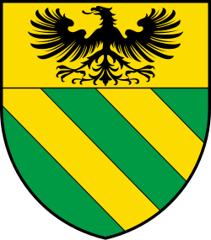
Veyrier
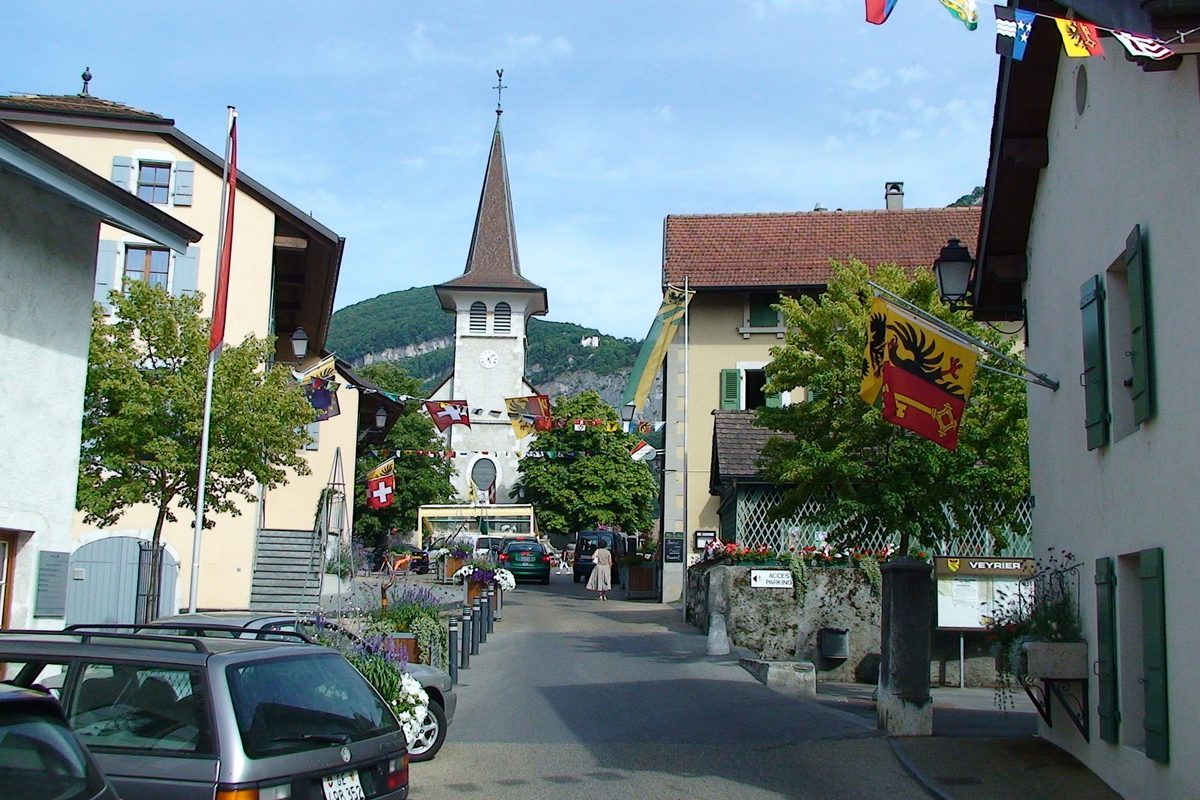
Origin of the name Veyrier
The form « Vayrie » is found in 1201. The name reportedly comes from a Latin personal name, Varius or Verius, the owner of a rural estate, followed by the suffix -acum designating a place.[1]
Founding of Veyrier
Nobody knows who founded the village. The parish is attested in 1201, but its foundation cannot be dated. The main landlord was the cathedral chapter of Genève, while the noble de Villette family, vassals of the counts of Genève, held part of the territory in fief from the fortified house of Symond or Cymont. Much earlier, around 10'000 BC, reindeer hunters sheltered under boulders close by: François-Isaac Mayor discovered their Magdalenian site, actually located on the neighbouring French territory of Etrembières, and successive excavations have shed light on their way of life. After the Bernese occupation, Veyrier returned to Savoy under a restricted sovereignty, the Seigneurie of Genève keeping numerous rights. The political municipality was created during the French occupation, and the second Treaty of Turin transferred Veyrier, a « commune réunie », to Genève and Switzerland. Largely rural until around 1950, the municipality then became a suburban residential area, above all in the 1960s and 1970s.[1]
History of Veyrier
around 10'000 BC. Reindeer hunters settle in rock shelters under boulders at the foot of the Salève, at the so-called Magdalenian site of Veyrier, actually located in Etrembières.[1]
1201. First mention of the name, in the form « Vayrie »; the parish is attested.[1]
1412. The church's dedication to Saint-Maurice is attested. The parish counts 30 hearths.[1]
1536. Bernese occupation of the region; the municipality becomes Protestant.[1]
1567. Bern returns the bailiwick of Ternier-Gaillard to the duke of Savoy. Veyrier comes under a restricted Savoyard sovereignty, the Seigneurie of Genève keeping numerous rights.[1]
17th century. At the beginning of the century the duke of Savoy restores Catholic worship.[1]
1754. The first Treaty of Turin makes Veyrier fully Savoyard.[1]
1778. Construction of the Sierne bridge, rebuilt in 1824 and in 1983.[1]
1782. Attachment to the province of Carouge.[1]
1792-1814. French occupation (department of Mont-Blanc, then of Léman from 1798). The political municipality is created during this period.[1]
1813. Veyrier is united with Etrembières.[1]
1816. Return to Savoy, then transfer to Genève and Switzerland under the second Treaty of Turin. Troinex is at first united with the municipality of Veyrier.[1][2]
1817. Troinex separates from Veyrier and becomes an autonomous municipality.[2]
1833. François-Isaac Mayor discovers the so-called Magdalenian site of Veyrier, on the neighbouring territory of Etrembières.[1]
1887. A narrow-gauge steam railway links Veyrier to Genève. It is replaced by an electric tramway in 1898, then by a bus in 1956.[1]
1892. Opening of a funicular to the Salève, replaced in 1932 by a cable car.[1]
Interwar period. The draining of the Arve marshes creates a market-gardening area.[1]
1960-1970. The construction of villas and rental buildings turns the municipality into a suburban residential area.[1]
Population of Veyrier
Sources and references: [1][4]
| 1412 | 30 hearths (households), parish |
| 1792 | 300 inhabitants approximately, parish |
| 1834 | 500 |
| 1850 | 567 |
| 1900 | 780 |
| 1950 | 1'813 |
| 2000 | 8'892 |
| 2025 | 12'269 |
Historic sites in Veyrier
Church of Saint-Maurice. Parish church whose dedication is attested in 1412, rebuilt in the 18th century.[1]
Sierne bridge. Bridge over the Arve built in 1778, rebuilt in 1824 and in 1983.[1]
Village castle. Castle built in the village in the 18th century, replacing the fortified house of Symond.[1]
Vessy and Pinchat. Hamlets of the municipality, whose clay allowed tile works to be set up.[1]
Jewish cemetery. Cemetery straddling the French-Swiss border: the main entrance is in Veyrier, most of the site in Etrembières, in France. The writer Albert Cohen and Zino Davidoff are among those buried here.[3]
Remains in Veyrier
Magdalenian site. Rock shelters under boulders used by reindeer hunters around 10'000 BC, discovered in 1833 by François-Isaac Mayor. The site actually lies on the neighbouring French territory of Etrembières.[1]
Les Berlies cemetery. Large cemetery of the Late Roman Empire and the early Middle Ages excavated at the end of the 19th century at the place called les Berlies, now in France.[1]
Fortified house of Symond. Fortified house of Symond or Cymont, above the Pas-de-l'Échelle road, centre of the lordship of the de Villette family; it has disappeared.[1]
Sources
- Dictionnaire historique de la Suisse, « Veyrier » (Isabelle Brunier), version du 08.07.2013
- Dictionnaire historique de la Suisse, « Troinex » (Dominique Zumkeller)
- Office de tourisme des Monts du Genevois, « Jewish cemetery in Veyrier » (cimetière israélite de Veyrier-Etrembières)
- Office cantonal de la statistique (OCSTAT), Mémento statistique du canton de Genève 2026, tableau Population résidante par commune, en 2025
- geo.admin.ch, service de recherche de swisstopo (coordonnées)
Localities of the municipality with a page
Other villages near Veyrier
Missing information, or do you have a source? Suggest a correction or addition. Every submission is checked before it's published.
Suggest a change