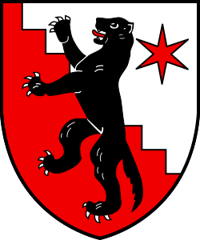
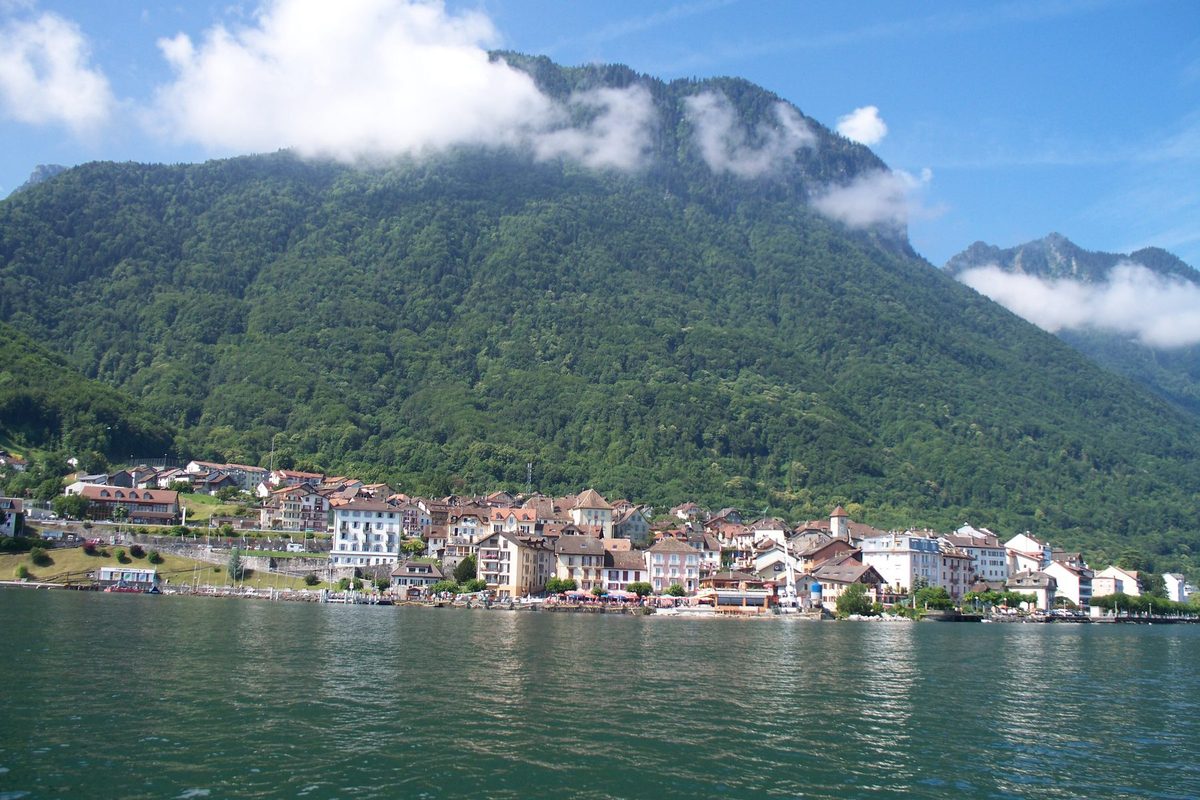
Saint-Gingolph
Origin of the name Saint-Gingolph
The name appears in 1153 as « Sanctus Gengulfus ». It is that of Saint Gingolph, patron of the parish church, presented as an officer of Pepin the Short. No other explanation is known.[1]
Founding of Saint-Gingolph
Nobody knows who founded Saint-Gingolph. The village grew up on the alluvial deposits of the Morge, on Lake Geneva. Its original church perhaps stood at Bret, west of the torrent, a place destroyed by the Tauredunum landslide. The lordship first belonged to the abbey of Ainay, then to that of Abondance, which installed a mayor and later a castellan. The village then formed a single community, until the Treaty of Thonon made the Morge a border. Since then the Valais municipality and the hamlet of Le Freney have faced the French municipality of the same name.[1]
History of Saint-Gingolph
563. The Tauredunum landslide destroys the place of Bret, west of the Morge, where the original church perhaps stood.[1]
1153. First mention, as « Sanctus Gengulfus ». The lordship belongs to the abbey of Ainay.[1]
1204. Probably before this date, the lordship passes to the abbey of Abondance.[1]
1536. The lordship recognises the authority of the seven dizains of Valais.[1]
1563. The abbot of Abondance cedes his rights to the Du Nant de Grilly family.[1]
1569. Through the Treaty of Thonon, the dizains keep only the territory on their side of the Morge.[1]
1570. The Valais part is attached to the governorship of Monthey. The village is divided in two.[1]
1585-1588. Date of the castle, later bought by the de Rivaz family.[1]
1646. The lordship passes from the Du Nant to the Riedmatten, who hold it until 1798.[1]
1677. Jacques de Riedmatten has the chapel of the Holy Family built.[1]
1798. The municipality is incorporated into the district of Monthey.[1]
1805-1807. Construction of a military road.[1]
1822. The parish, shared by the two Saint-Gingolphs, passes from the diocese of Geneva to that of Annecy.[1]
1829. Creation of a small free zone, later absorbed into the Great Zone of Northern Savoy, then restored in 1933.[1]
1878. Opening of the railway line to Le Bouveret. The line to Evian runs from 1886 to 1998.[1]
1900. Around this date the municipality acquires the castle, after the de Rivaz family, and makes it its town hall.[1]
1944. In July almost the entire population of the French municipality crosses into Switzerland before the SS set fire to the village. During the Second World War 689 refugees cross the border at Saint-Gingolph and 167 are turned back.[1]
1980. Closure of the shipyard, active since the 17th century.[1]
Population of Saint-Gingolph
Sources and references: [1][2]
| 1802 | 321 |
| 1850 | 627 |
| 1860 | 826 |
| 1900 | 660 |
| 1930 | 607 |
| 1950 | 801 |
| 2000 | 773 |
| 2010 | 853 |
| 2020 | 933 |
| 2025 | 1'103 |
Historic sites in Saint-Gingolph
Castle of Saint-Gingolph. Dated 1585-1588, bought by the de Rivaz family and then by the municipality, which made it its town hall around 1900.[1]
Parish church of Saint-Gingolph. Located on the left bank of the Morge and dedicated to Saint Gingolph, it serves both municipalities. The parish belongs to the diocese of Geneva from the 12th century, then to that of Annecy from 1822, making Saint-Gingolph the only Swiss locality under a foreign diocese.[1]
Chapel of the Holy Family. Built in 1677 by Jacques de Riedmatten. Another chapel had been built by the Du Nant family.[1]
The Morge. Border torrent which, since the Treaty of Thonon of 1569, separates the Valais municipality from the French municipality of the same name.[1]
Sources
- Dictionnaire historique de la Suisse, « Saint-Gingolph » (Patrick Maye, version de 2009, remanié le 21.07.2010)
- Office fédéral de la statistique (OFS), STATPOP, chiffres provisoires au 31.12.2025, via citypopulation.de
- geo.admin.ch, recherche de lieux (coordonnées)
Other villages near Saint-Gingolph
Missing information, or do you have a source? Suggest a correction or addition. Every submission is checked before it's published.
Suggest a change