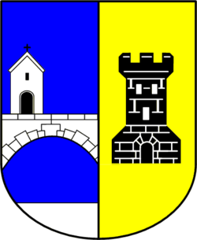
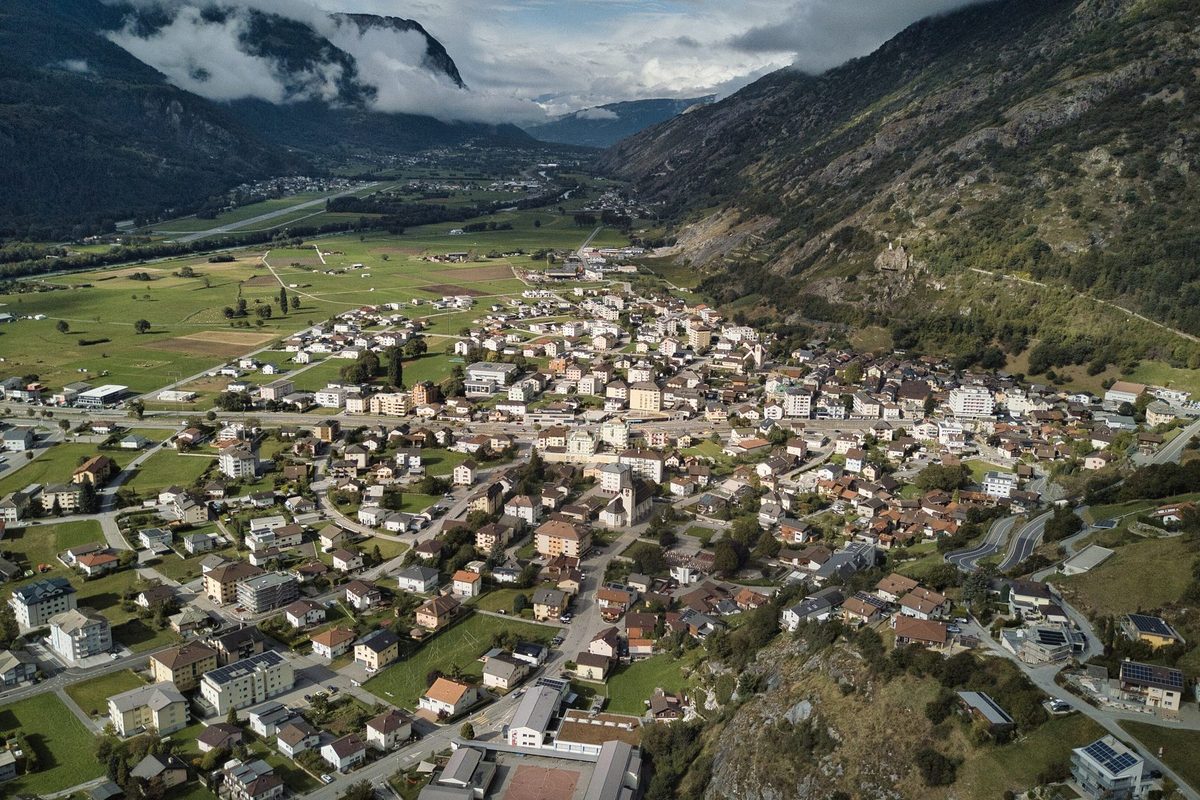
Steg
Origin of the name Steg
The place appears in 1300 in the forms « stegue » and « benke ». What the name means is not yet known.[1]
Founding of Steg
Alemanni settled the area in the 7th-8th centuries, on the left bank of the Lonza, at the entrance to the Lötschental. In the 13th century Steg depended on the barons de la Tour. Their rights passed to the Asperlin of Baltschieder, then by marriage to the Raron family, who sold them to the village community. This gave rise to the independent jurisdiction (Freigericht) of Benken, later called the commune and jurisdiction of Steg. The five upper dizains and the castellan of Niedergesteln long contested its legitimacy. In church matters Steg first depended on the priory of Niedergesteln. The correction of the Rhône made the plain farmable, and in the 20th century the farming village became a workers' village. It is now part of the municipality of Steg-Hohtenn.[1][2]
History of Steg
7th-8th century. Settlement of the area by the Alemanni.[1]
13th century. Steg depends on the barons de la Tour.[1]
1300. Mentioned in the forms « stegue » and « benke ».[1]
1307. The rights of the barons de la Tour are bought by the Asperlin of Baltschieder. They then pass by marriage to the Raron family.[1]
1434. The Raron family sell their rights to the village community: birth of the independent jurisdiction (Freigericht) of Benken.[1]
1553. The legitimacy of the jurisdiction, long contested by the five upper dizains and the castellan of Niedergesteln, is recognised by the Bishop of Sion and the Valais Diet.[1]
1564. Village statutes of Steg and Niedergesteln.[1]
1588. Steg, Hohtenn and Niedergesteln divide their common property.[1]
1661. Chapel of St Sebastian.[1]
1727. The jurisdiction is henceforth called the commune and jurisdiction of Steg.[1]
1863-1884. Correction of the Rhône; the drained plain becomes farmland, leading to population growth and very low emigration.[1]
1913. Steg forms a parish with Hohtenn.[1]
1913-1914. Construction of the neo-Romanesque Church of the Holy Family, replacing the Chapel of St Sebastian.[1]
1962. Alusuisse settles at Stegerfeld, strengthening the industrial character of the municipality.[1]
1970. The secondary sector provides 73% of jobs (still 53% in 2005, tertiary sector 44%).[1]
2007. Voters in Steg and Hohtenn approve the merger, on 16 December according to the date given, which is uncertain.
2009. Merger with Hohtenn on 1 January: creation of the municipality of Steg-Hohtenn.[1][2]
Population of Steg
Sources and references: [1]
| 1798 | 122 inhabitants |
| 1850 | 153 inhabitants |
| 1900 | 388 inhabitants |
| 1950 | 688 inhabitants |
| 2000 | 1'336 inhabitants |
Historic sites in Steg
Church of the Holy Family. Neo-Romanesque parish church built in 1913-1914, when the parish of Steg and Hohtenn was created. It replaced the Chapel of St Sebastian of 1661.[1]
Benken. Name of the independent jurisdiction (Freigericht) created when the villagers bought out the seigneurial rights in 1434, recognised in 1553.[1]
Stegerfeld. Plain reclaimed from the Rhône after its correction (1863-1884), where Alusuisse settled in 1962.[1]
Sources
- Dictionnaire historique de la Suisse, « Steg » (Bernard Truffer, trad. Catherine Pécoud, version du 05.01.2017)
- Etat du Valais, Service des affaires intérieures et communales (SAIC), « Rapport sur les finances communales 2008 » (février 2010), tableau des fusions de communes en Valais depuis 2000
- geo.admin.ch, recherche de lieux (coordonnées)
Other villages near Steg
Missing information, or do you have a source? Suggest a correction or addition. Every submission is checked before it's published.
Suggest a change