Verrerie de Roches
Origin of the name Verrerie de Roches
The sources call the site « la Verrerie de Rebeuvelier dite de Roche(s) ». The place name today is La Verrerie. The origin of the name « Roches » remains unexplained.[1][4]
Founding of Verrerie de Roches
The glassworks was founded from scratch in 1797 on the territory of Rebeuvelier, now in the municipality of Courrendlin (merger of 1 January 2019). The Revolution made it possible by ending the master glassmakers' monopoly, replacing the limits on the right to set up a business with a simple licence. The founders, Joseph Koetschet, Germain Bronner and Jean Baptiste Coste, were all in the service of the Département du Mont-Terrible. They had first bought forests and launched a first glassworks project that failed. They chose the location carefully: on the road from Biel to Basel, close to raw materials (wood, sand, clay) and to a stream supplying water power. A glassmakers' hamlet grew up around the works.[1][4]
History of Verrerie de Roches
1797. The glassworks is founded by Joseph Koetschet, Germain Bronner and Jean Baptiste Coste, in the service of the Département du Mont-Terrible.[1]
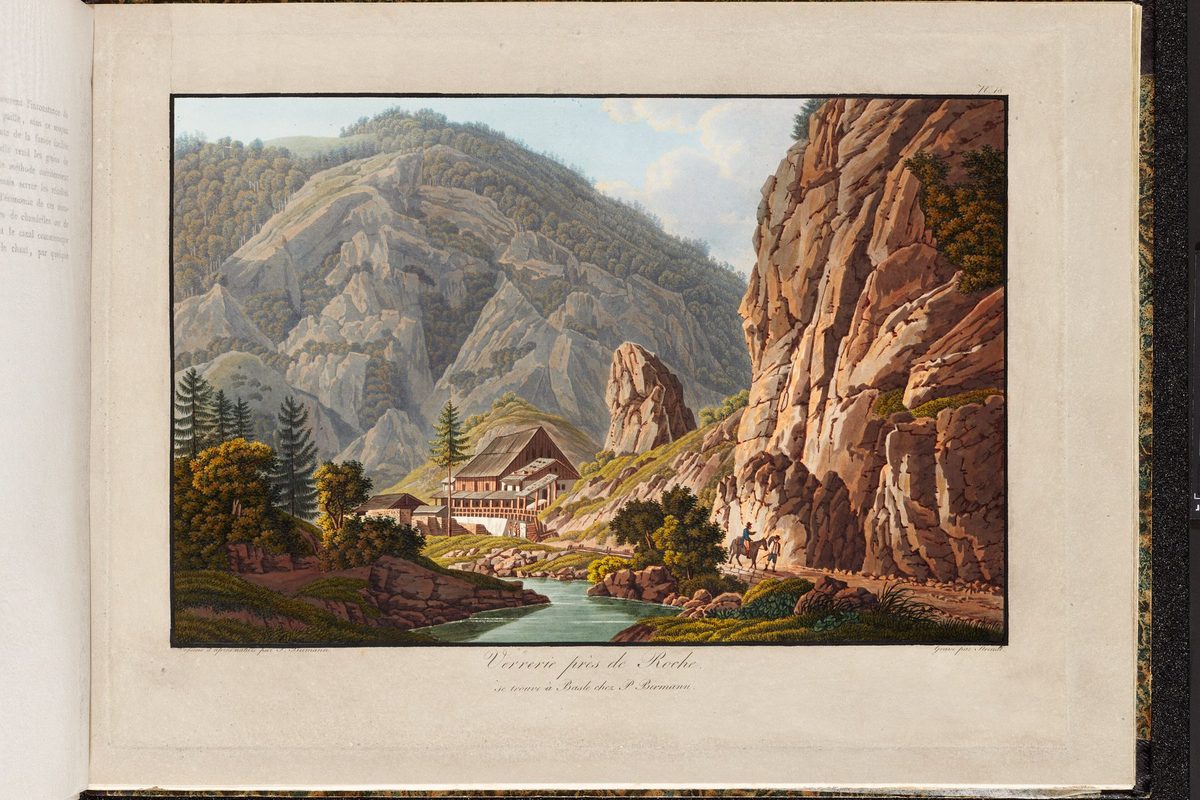
1802. Date of the oldest known depiction of the site, an aquatint by Birmann.
1805. Célestin Châtelain leases the glassworks.[3]
1817. Célestin Châtelain buys the glassworks.[3]
1825. Date of the oldest known plan of La Verrerie.
1850. The cadastral plan shows the extension of the glassmakers' hamlet.
1867. The melting furnace is finally put out. No other craft activity takes place on the site afterwards.[1]
2003. Archival research and mechanical test trenches ahead of the construction of the A16 motorway (Transjurane) and the Choindez half-junction.
2004-2005. Archaeological excavation from June 2004 to February 2005: about 1'500 m² and 203 features, including the furnace hall and the mill.
2013. The results are published in Cahier d'archéologie jurassienne 35, « Rebeuvelier, La Verrerie, redécouverte d'un passé préindustriel ».
Historic sites in Verrerie de Roches
La Verrerie hamlet. The other buildings of the site, the director's house, workers' houses, inn, workshop, forge and stable, were not affected by the motorway works. They lie under forest cover and their condition has not been assessed.
Remains in Verrerie de Roches
Furnace hall and mill. The excavation uncovered the melting hall, with secondary furnaces set along the walls according to their function (preparation of raw materials to the north, annealing to the south and east), as well as a wood-drying furnace and fritting, preheating and bending furnaces. The mill was used in particular to grind chamotte and wash sand. Clay extraction pits from the first phases show that the crucibles were made on site.[1]
Archaeological finds. The finds cover the whole glassmaking process (raw materials, waste, tools, a wide variety of finished objects). Daily life in the hamlet left tableware, cooking pots, buttons, shoes, toys and pipes.[1]
Sources
- Office de la culture du Jura, résumé du Cahier d'archéologie jurassienne 35
- E. Evéquoz et U. Babey, « Rebeuvelier, La Verrerie, redécouverte d'un passé préindustriel », Cahier d'archéologie jurassienne 35, Porrentruy, 2013
- Dictionnaire historique de la Suisse, « Châtelain » (André Bandelier)
- Dictionnaire historique de la Suisse, « Rebeuvelier » (François Kohler)
- Office fédéral de topographie swisstopo, map.geo.admin.ch
Other villages near Verrerie de Roches
Missing information, or do you have a source? Suggest a correction or addition. Every submission is checked before it's published.
Suggest a change