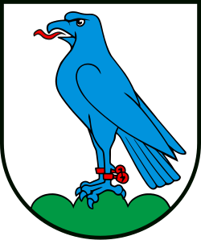
Courrendlin
Listed in 866 among the possessions of the abbey of Moutier-Grandval, the street village on the Birs saw the Von Roll blast furnace of Choindez fired up in 1846, at the mouth of the Moutier gorge.
Entry based on 8 sources · Our method · Reusable text (CC BY-SA)
Origin of the name Courrendlin
Courrendlin first appears in 866, as « Rendelana Corte ». No one has yet explained the name « Courrendlin ».[1]
Founding of Courrendlin
Courrendlin appears in 866 among the possessions of the abbey of Moutier-Grandval. The old core developed as a street village on the right bank of the Birs, at the mouth of the Moutier gorge. Until 1797, Courrendlin was one of the great judicial mayoralties of the provostship of Moutier-Grandval, also called Sous-les-Roches, which united the mayoralties of Courrendlin and Corban. In the 19th century the village was transformed by the ironworks of Choindez. The present municipality was created on 1 January 2019 by the merger of Courrendlin with Rebeuvelier and Vellerat. It also includes the industrial site of Choindez.[1][2]
History of Courrendlin
866. First mention (« Rendelana Corte »): Courrendlin is among the possessions of the abbey of Moutier-Grandval.[1]
13th-14th century. Construction of the choir and part of the nave of the old church of Saint-Barthélemy, which still survive.[3]
1530s. Despite Bernese efforts, the mayoralty of Courrendlin remains Catholic.[1]
1598. The Prince-Bishop of Basel has a blast furnace built at Courrendlin, active until around 1870.[1]
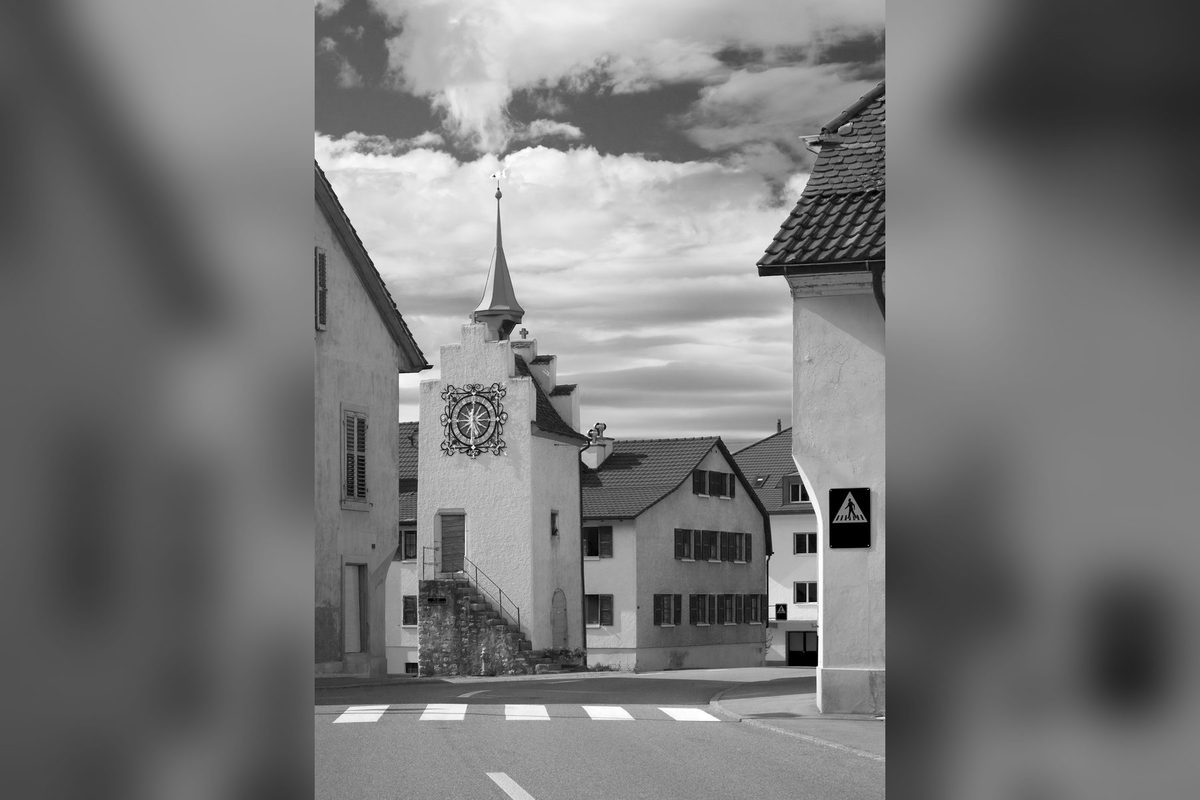
1697. Date of the dials of the clock tower.[3]
1755-1758. Construction of the parish church of Saints-Germain-et-Randoald in the village. The old church of Saint-Barthélemy is abandoned in the middle of the 18th century.[1]
1797. End of the Ancien Régime: French period (Mont-Terrible 1797-1800, then Haut-Rhin 1800-1813).[1]
1815. Courrendlin joins the canton of Bern, in the bailiwick and then district of Moutier.[1]
1846. Ludwig von Roll fires up the Choindez blast furnace (the Von Roll works have been established there since 1843).[2][3]
1876. Opening of the station on the Delémont-Moutier line. Choindez also has a station from 1876.[1][2]
1920. 74 % of the working population is employed in industry, with a strong German-speaking and Protestant minority.[1]
1930. Construction of the Reformed church.[1]
1933. Opening of a secondary school.[1]
1975. A border municipality after the plebiscites of June 1974 and March 1975, Courrendlin opts for the canton of Jura on 7 September 1975.[1]
1977 (or 1975-1976). Restoration of the old church of Saint-Barthélemy.[1][3]
1976. Attached to the district of Delémont.[1]
2019. On 1 January, merger with Rebeuvelier and Vellerat into the municipality of Courrendlin.[1]
Population of Courrendlin
Sources and references: [1]
| 1818 | 567 |
| 1850 | 731 |
| 1900 | 1'908 |
| 1910 | 2'098 |
| 1930 | 1'921 |
| 1950 | 2'218 |
| 1970 | 2'656 |
| 2000 | 2'435 |
| 2010 | 2'564 |
| 2019 | 3'550 (merged municipality) |
| 2025 | 3'737 (merged municipality) |
Families of Courrendlin
Citizen families before 1800. The list predates the 2019 merger with Rebeuvelier and Vellerat. It counts twelve old families: Beuglet, Chalverat, Champion, Fromaigeat, Girardin, Greppin, Jardin, Périnat, Riard, Sauvain, Scherrer and Seuret.[7]
In the 19th century. The Klinger, with no exact date, and the Gugler, who came from Germany in 1895.[7]
From 1901 to 1962. Ten names, several of them from Italy: Luraschi (registered in 1931, 1943 and 1944), Rossinelli (1945) and Degli Esposti-Venturi (1953). The Bruder (1925), the Wagner (1935) and the Gaulke (1951) come from Germany, the Heinis (1925), the Mavon (1928) and the Bacher (1932) from France. The Muller close the list in 1957.[7]
Notable people of Courrendlin
Raoul Kohler (1921-2013). Born in Courrendlin, he taught secondary school there (1945-1947) before teaching in Biel and heading its French progymnasium. A member of the Biel municipal executive from 1965 to 1982 and a Radical member of the Bern Grand Council, he sat in the National Council from 1971 to 1991.[8]
Economy of Courrendlin, past and present
The prince-bishop's ironworks. The blast furnaces of Courrendlin and Undervelier start work in 1599. In 1714 the people of Bassecourt are obliged to supply ore to the Courrendlin furnace. On 27 April 1797 the ironworks are sold as national property. In 1806 their masters are ordered to make scythes and sickles or lose their rights. The Louis de Roll company acquires the Undervelier and Courrendlin ironworks in 1880.[6]
From Von Roll to plastics. In the second half of the 19th century the Von Roll works at Choindez transform the municipality. Diversification speeds up from 1970. In 2000 industry provides more than half of all jobs, with the foundry, engineering, bar turning, plastics and gravel extraction.[1]
Disasters and major events in Courrendlin
The Swabian War in 1499. During the Swabian War, Austrians lay waste to Courrendlin, along with Champoz, Corban and Mervelier. On 22 May 1499 a fire strikes Courrendlin. On 16 August a troop of Austrian soldiers occupies the village.[6]
The fire of 1881. On 28 September 1881 three houses burn down.[6]
Historic sites in Courrendlin
Church of Saints-Germain-et-Randoald. Parish church built in 1755-1758, whose three Baroque altars by Ursanne-Joseph Bourquardt are among the most remarkable in the canton. Paintings by François-Ignace Tavanne (1757). Restored in 1982-1983 and 1988. The parish also includes Rossemaison, Châtillon and Vellerat.[1][3]
Clock tower. 17th-century tower with stepped gables, whose dials are dated 1697. Restored in 1965 and 1990.[3]
Street village. The old core stretches along the right bank of the Birs, with winding streets, farmhouses and townhouses (1657-1823). The station and a 20th-century residential district are on the left bank.[1][3]
Choindez. Industrial site in a widening of the Moutier gorge, developed around the Von Roll blast furnace of 1846. It became one of the main Swiss ironworks (cast-iron pipes and moulds) and had more than 700 workers in 1913. Before 1914, Von Roll built thirty-five apartment houses, a canteen, a shop, a school and a small hospital there. The workers' settlement gradually lost its inhabitants (704 in 1910, 24 in 2000).[2]
Remains in Courrendlin
Old church of Saint-Barthélemy. Oldest building in the municipality, abandoned in the middle of the 18th century. The choir and part of the nave from the 13th-14th centuries survive, with wall painting fragments from the middle of the 15th century. Restored in 1977 (or 1975-1976).[1][3]
Choindez blast furnace. The blast furnace of 1846 and the industrial buildings and housing of the late 19th century form an ensemble listed in the municipal heritage inventory.[2][3]
Protected heritage in Courrendlin
Cultural property of regional significance (B objects)[5]
- Ancienne église St-Barthélemy
- Eglise St-Germain-et-St-Randoald
- Maison d'habitation
- Tour de l'horloge
Sources
- Dictionnaire historique de la Suisse, « Courrendlin »
- Dictionnaire historique de la Suisse, « Choindez »
- Commune de Courrendlin, Règlement communal sur les constructions, annexe I (inventaire du patrimoine)
- Statistique Jura, tableau JU-T.01.01.03, population résidante permanente au 31 décembre 2025
- Federal Office for Civil Protection (FOCP), Swiss Inventory of Cultural Property (PCP), list for the canton of Jura (as of 1.1.2026)
- Chronologie jurassienne (Denis Moine), « Courrendlin »
- Register of Swiss Surnames, 3rd edition (1989), search Commune "Courrendlin", Canton JU
- Dictionnaire historique de la Suisse, « Kohler, Raoul », version du 28.11.2013
Published by Sébastien Jörg ·
Localities of the municipality with a page
Other villages near Courrendlin
Missing information, or do you have a source? Suggest a correction or addition. Every submission is checked before it's published.
Suggest a change