Châtillon
In 1975 this street village south of Delémont, on the new border between Bern and Jura, chose the canton of Jura. Since the 12th century it had belonged to the chapter of Moutier-Grandval.
Entry based on 8 sources · Our method · Reusable text (CC BY-SA)
Origin of the name Châtillon
The name is said to come from a Roman watchtower that once stood on the Mont Chaibeut, where traces of a fortified camp attributed to the Romans have been found. The village appears in 1148 as « Chastellun ». Several twelfth-century documents confirm the holdings of the chapter of Moutier-Grandval in Châtillon.[1][5]
Coat of arms of Châtillon
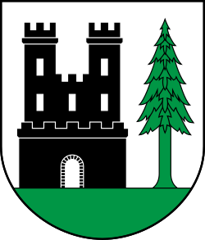
Argent, a castle Sable, accompanied to sinister by a fir tree Vert on a mount of the same. On a white field stands a black castle. To its right, as seen by the viewer, a green fir tree grows on green ground. The Bernese government approved these arms on 9 January 1947.[7]
Founding of Châtillon
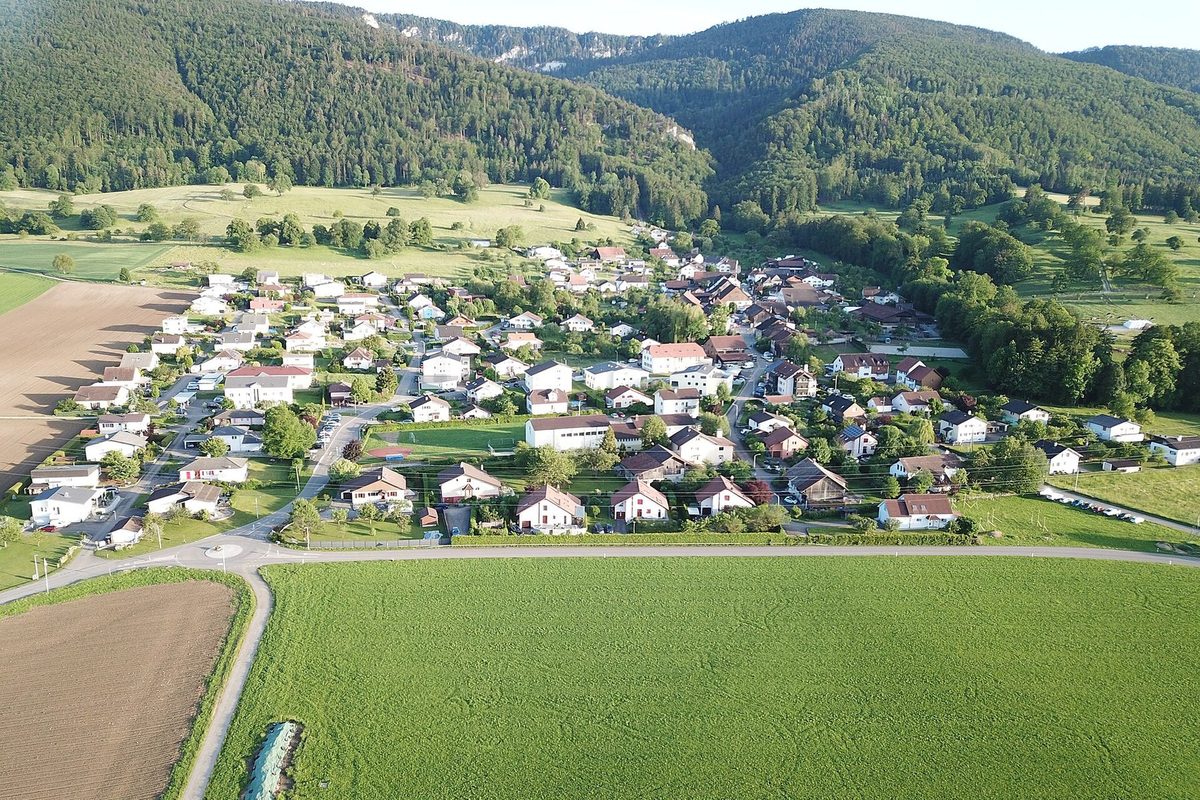
Châtillon is a street village south of Delémont, in a small valley on the northern slope of the Mont chain. Mentioned in 1148, it belonged from the 12th century to the chapter of Moutier-Grandval and was part of the provostry of Moutier-Grandval, in the area known as Sous-les-Roches.[1]
History of Châtillon
1148. First mention of the village, as « Chastellun ».[1]
12th century. The village is a possession of the chapter of Moutier-Grandval and part of the provostry, Sous-les-Roches area. A noble family of Châtillon then has its seat in the village.[1][5]
17th century. Plague strikes the village. Its victims are buried together, apart, in a plot marked with a cross known as the plague cemetery.[5]
1797-1814. French period.[1]
1815. Châtillon is attached to the Bernese district of Moutier.[1]
1817. The chapel of the Assomption-de-la-Vierge is built. The village remains part of the parish of Courrendlin.[1]
1854. Separation of the citizens' community and the municipality.[1]
Around 1900. The village has 36 houses and 217 inhabitants, mostly Catholic, of Courrendlin parish. Crops and cattle are raised, and a small post office serves it.[5]
1975. As a municipality on the new border between Bern and the Jura, Châtillon chooses the canton of Jura.[1]
2000. Farming and residential village: more than two thirds of the working population work elsewhere.[1]
Population of Châtillon
Sources and references: [1]
| 1818 | 144 |
| 1850 | 193 |
| 1880 | 152 |
| 1900 | 221 |
| 1950 | 343 |
| 1970 | 299 |
| 2000 | 378 |
| 2010 | 433 |
| 2025 | 500 |
Families of Châtillon
The citizens of Châtillon. Only four families held citizenship before 1800, with no precise date: Chalverat, Comte, Cortat and Seuret. The 1989 survey adds just one family, the Weichlinger, from Austria, registered in 1935.[8]
Notable people of Châtillon
Nicolas Comte. In February 1808 the municipal council received the deed of the donation he made with his wife for a chapel.[7]
André Brêchet. Painter. On 6 September 1992 his works were blessed in the Châtillon chapel.[7]
Economy of Châtillon, past and present
Fields and creamery. Châtillon remains a farming village. The Société de laiterie de Châtillon was founded in November 1924. A land drainage project was launched in 1942, followed by a land consolidation in 1982.[1][7]
Ore, mill and beer. In 1803 the use of the Châtillon iron mine was confirmed to its operators. An imperial decree authorised a mill with a sawmill in 1810. In 1918 the Bernese government granted the Louis de Roll company a concession to extract iron ore in six communes, including Châtillon. The Brasserie du Bief was set up in 2006.[7]
Historic sites in Châtillon
Chapel of the Assomption-de-la-Vierge. Chapel built in 1817; the village remains part of the parish of Courrendlin.[1]
Protected heritage in Châtillon
Cultural property of national significance (A objects in the PCP inventory)[6]
- Maison paysanne double avec les dépendances agricoles juxtaposés
Legends of Châtillon
The swallowed castle of Mont-Chaibeut. On Mont-Chaibeut, an isolated hill north-east of Châtillon, tradition placed the castle of Atticus, a 7th-century duke of Alsace. Because he had Saint Germanus, first abbot of Grandval, put to death, God is said to have swallowed up his castle in an earthquake. Quiquerez points out that the castle is legendary: Atticus was actually camped in the plain.[4]
The horns and the witches. Another tradition held that signals were sent from the castle on Mont-Chaibeut to Soyhières with bronze horns. Witches were also said to hold their night-time gatherings there, perhaps because criminals had once been executed on the hill.[4]
Traditions and festivals in Châtillon
Races and village fete. The Tour de Châtillon was run on 23 May 1965, then several more times up to 1981. A soapbox race was held in 1968, and others followed up to 1979. The first village fete took place on 24 June 2000.[7]
Sources
- Dictionnaire historique de la Suisse, « Châtillon (JU) » (François Kohler)
- Statistique Jura, tableau JU-T.01.01.03, population résidante permanente au 31 décembre 2025
- geo.admin.ch (swisstopo), recherche de lieux « Châtillon JU »
- Auguste Quiquerez, Le Mont-Terrible, 1862, p. 191-198
- Geographisches Lexikon der Schweiz, Band I (Neuenburg, Attinger, 1902)
- Federal Office for Civil Protection (FOCP), Swiss Inventory of Cultural Property (PCP), list for the canton of Jura (as of 1.1.2026)
- Denis Moine, Chronologie jurassienne, "Châtillon"
- Register of Swiss Surnames, 3rd edition (1989), search Commune "Châtillon", Canton JU
Published by Sébastien Jörg ·
Other villages near Châtillon
Missing information, or do you have a source? Suggest a correction or addition. Every submission is checked before it's published.
Suggest a change