Vuarrens
At the crossroads of the Lausanne-Yverdon-les-Bains and Moudon-Orbe roads, Vuarrens had a Roman villa excavated in 1828 and was a castellany of the Bernese bailiwick of Yverdon.
Entry based on 9 sources · Our method · Reusable text (CC BY-SA)
Origin of the name Vuarrens
The village is mentioned in 1147 in the form «Vuarens», then in 1177 as «Warens». The name may come either from a word «warus» (enclosure) or from the name of a Roman family, «Waro». Another explanation sees in it a name of Burgundian origin, from a primitive «Waringos», «at the home of the Waringi».
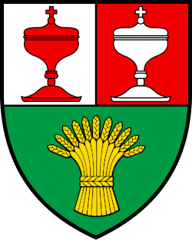
Coat of arms of Vuarrens
Per fess, first argent and gules two ciboria counterchanged, second vert a garb or. The shield is divided horizontally. At the top, on a white and red field, two ciboria each take the colour opposite to the field. At the bottom, a yellow sheaf stands out against a green field.[6]
Founding of Vuarrens
A Roman villa, excavated in 1828, shows that the site was occupied in Roman times. In the Middle Ages the bishop and the cathedral chapter of Lausanne held most of the property and rights in Vuarrens. Nobody knows who founded Vuarrens, or when.
History of Vuarrens
Roman period. A Roman villa is built in the area. It will be excavated in 1828.
1147. First mention in the form «Vuarens».
1177. The village appears as «Warens».
Middle Ages. The bishop and the cathedral chapter of Lausanne hold most of the property and rights in Vuarrens.
1228. The parish is recorded.
1416. The village has 42 hearths (households), then 27 in 1453.
1536-1798. Vuarrens is a castellany of the Bernese bailiwick of Yverdon. From the Reformation, the parish also includes Essertines-sur-Yverdon and, until 1724, Pailly.
1675. The lordship is in the hands of the nobles of Lavigny, then of the Loys and the de Joffrey.
1705. The present church is restored and the parsonage rebuilt.
1728. Jean-Pierre Bergier, of Lausanne, acquires the lordship.
1798. Vuarrens is attached to the district of Échallens, until the end of 2007. During the Vaud Revolution, the intervention of Jean-François Paul Grand is said to have allowed an early abolition of feudal rights.
1828. Excavation of the Roman villa.
1964. Land consolidation.
2008. On 1 January Vuarrens joins the district of Gros-de-Vaud, created by the new territorial division of Vaud.[4]
21st century. Traditionally devoted to livestock and dairy farming, Vuarrens is becoming increasingly residential, especially in Vuarrengel.
2025. The municipality has 1'113 inhabitants on 31 December.[3]
Population of Vuarrens
Sources and references: [3]
| 1416 | 42 hearths (households) |
| 1453 | 27 hearths (households) |
| 1803 | 426 |
| 1850 | 549 |
| 1900 | 532 |
| 1950 | 429 |
| 2000 | 565 |
| 2025 | 1'113 |
Families of Vuarrens
Citizen families before 1800. Sixteen families, all with no precise date: Barbey, Brot, Buffat, Debamp, Doxat, Dupuis, Favez, Gasser, Gonet, Narbel, Tardy, Thierry, Vulliamoz, Vulliémoz, Wulliémoz and Ybloux.[7]
In the 19th century. The Gasset and the Martin, with no precise date.[7]
From 1901 to 1962. Five entries, four of them Bernese families. Nydegger of Rüschegg BE were entered in 1956, other Nydegger, of Wahlern BE, in 1957, the same year as the Anker of Lüscherz BE and the Buri of Boltigen BE. The Sunier closed the list in 1958.[7]
Notable people of Vuarrens
Jean-Claude Piot (1927-2011). Born in Vuarrens, Jean-Claude Piot qualified as an agricultural engineer at ETH Zurich and taught at the Marcelin agricultural school in Morges. As director of the Federal Office for Agriculture from 1969 to 1992, he worked to steer Swiss agriculture towards liberalism.[8]
Philippe Meylan (1893-1972). A jurist born in Vuarrens, Philippe Meylan taught Roman law at the University of Lausanne from 1923 to 1964 and served as dean of the law faculty. He ranked among the most important legal historians in Switzerland and Europe. In 1937 he protested against the award of an honorary doctorate to Mussolini.[9]
Historic sites in Vuarrens
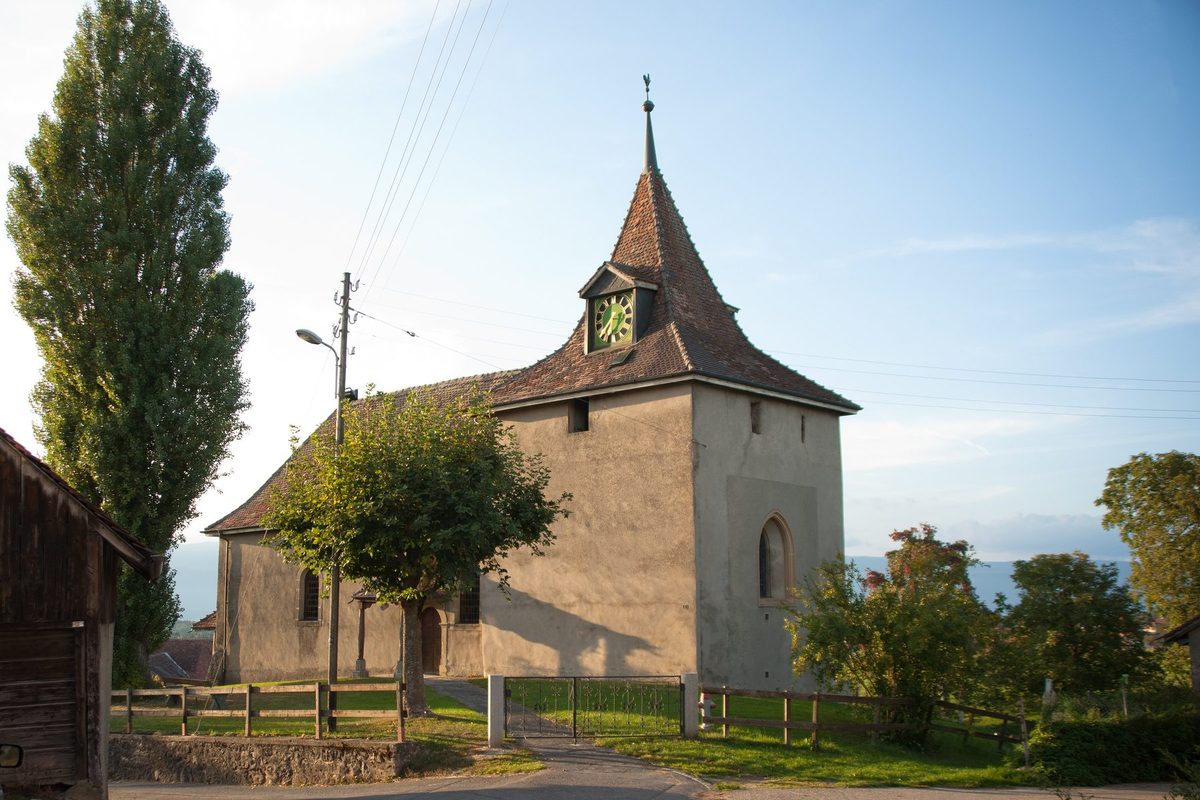
Temple of Vuarrens. Parish church recorded from 1228, restored in 1705, the year the parsonage was rebuilt. The temple is reportedly listed as a cultural property of regional importance.
Hamlet of Vuarrengel. Hamlet of the municipality, where recent residential growth is concentrated.
Remains in Vuarrens
Roman villa. Villa from the Roman period uncovered during excavations in 1828.
Protected heritage in Vuarrens
Cultural property of regional significance (B objects)[5]
- Eglise réformée Notre-Dame
Legends of Vuarrens
The nickname «Bâo». The inhabitants are reportedly nicknamed «Lè Bâ» or «Bâo», meaning the Oxen in Vaud patois.
Sources
- Dictionnaire historique de la Suisse, « Vuarrens »
- Henry Suter, « Noms de lieux de Suisse romande, Savoie et environs », lettre V
- Statistique Vaud, « Population résidante permanente au 31 décembre 2025 »
- État de Vaud, communiqué du 12.07.2007, « Organisation des préfectures et adaptation au nouveau découpage territorial »
- Federal Office for Civil Protection (FOCP), Swiss Inventory of Cultural Property (PCP), list for the canton of Vaud (as of 1.1.2026)
- IPI, Swissreg, emblems database: coat of arms of Vuarrens (no. 102106)
- Register of Swiss Surnames, 3rd edition (1989), search Commune "Vuarrens", Canton VD
- Dictionnaire historique de la Suisse, « Piot, Jean-Claude », version du 19.01.2011
- Dictionnaire historique de la Suisse, « Meylan, Philippe », version du 10.11.2009
Published by Sébastien Jörg ·
Localities of the municipality with a page
Other villages near Vuarrens
Missing information, or do you have a source? Suggest a correction or addition. Every submission is checked before it's published.
Suggest a change