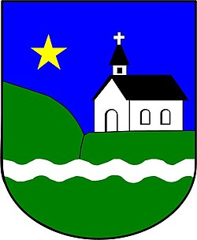
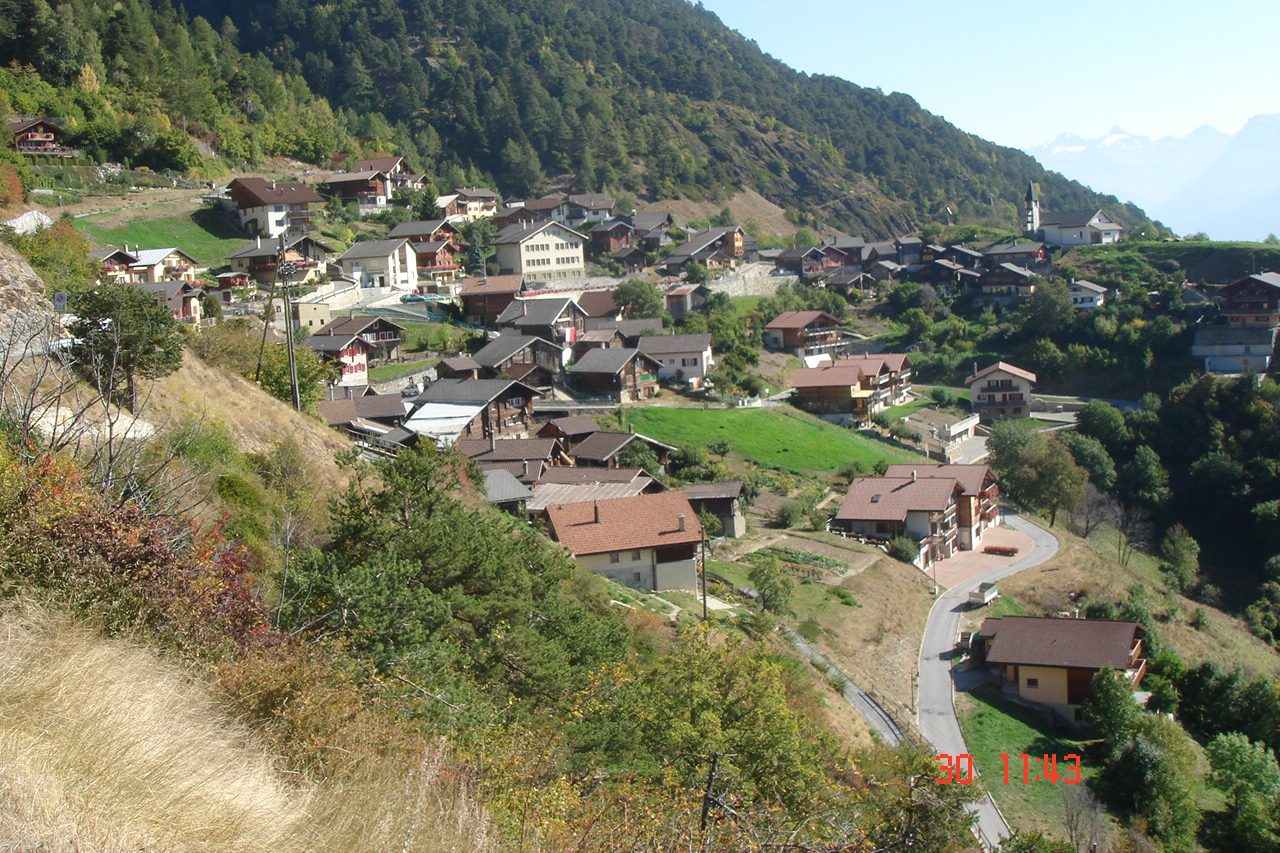
Bratsch
Origin of the name Bratsch
The name appears in 1228 and 1242 as « Praes », then as « Prahcs » (1309), « Praes » (1322), « Prayes » (1357), « Prages » (1408) and finally « Bratsch » (1532). Its origin is not explained.[1]
Founding of Bratsch
Bratsch spreads over several levels on the right bank of the Rhône: the village on a terrace halfway up the slope, the hamlet of Änggersch higher up, Getwing and Niedergampel on the plain. Alemannic immigration Germanised the population, a process completed in the 15th century. The communitas, first mentioned in the 14th century, belonged to the vidomnat of Leuk, which later passed to the dizain of the same name. Änggersch once held a rank in the commune equal to that of Bratsch, as the statute of 1672 and a list of burghers of 1826 show, but lost it in the 19th century. In church matters Bratsch depended on Leuk until the parish of Erschmatt-Bratsch was created. The commune later grew by taking in part of Niedergampel, formerly a seasonal settlement.[1][3]
History of Bratsch
1228. First mention as « Praes ».[1]
14th century. First mention of the communitas, part of the vidomnat of Leuk.[1]
15th century. Germanisation resulting from Alemannic immigration is complete.[1]
1532. The name appears as « Bratsch ».[1]
1613. The vidomnat of Leuk passes to the dizain of the same name.[1]
17th century. The chapel of Our Lady is built.[1]
after 1666. A cemetery for plague victims is laid out at Erschmatt.[1]
1672. Statute of the commune, in which Änggersch holds a rank equal to that of Bratsch.[1]
1721. Founding of the parish of Erschmatt-Bratsch. Bratsch no longer depends on Leuk in church matters.[1]
1826. List of burghers still attesting the rank of Änggersch, which the hamlet loses during the 19th century.[1]
1873. The commune grows through the partial attachment of Niedergampel, formerly a seasonal settlement.[1]
1897. After the Lonza works open in Gampel, farming (vineyards on the plain, cereals in two-field rotation, livestock) shifts towards more extensive forms.[1]
1990. 94 % of the working population works outside the municipality.[1]
2009. On 1 January, Bratsch merges with Gampel to form the municipality of Gampel-Bratsch. The merger was reportedly approved by vote on 20 January 2008, a date that is uncertain.[1][3]
Population of Bratsch
Sources and references: [1]
| 1798 | 166 inhabitants |
| 1850 | 128 inhabitants |
| 1900 | 199 inhabitants |
| 1950 | 458 inhabitants |
| 1970 | 503 inhabitants |
| 2000 | 464 inhabitants |
Historic sites in Bratsch
Village of Bratsch. Main village, on a terrace halfway up the right bank of the Rhône.[1]
Chapel of Our Lady. The village's 17th-century chapel.[1]
Änggersch. Hamlet above Bratsch which once held a rank in the commune equal to that of the village (statute of 1672, list of burghers of 1826) and lost it in the 19th century.[1]
Niedergampel. Former seasonal settlement on the plain, partly attached to the commune in 1873.[1]
Sources
- Dictionnaire historique de la Suisse, « Bratsch » (Gregor Zenhäusern, trad. Françoise Senger, version de 1998 remaniée le 04.01.2017)
- geo.admin.ch, recherche de lieux (coordonnées)
- Etat du Valais, Service des affaires intérieures et communales, « Rapport sur les finances communales » (comptes 2008, février 2010), tableau des fusions de communes depuis 2000
Other villages near Bratsch
Missing information, or do you have a source? Suggest a correction or addition. Every submission is checked before it's published.
Suggest a change