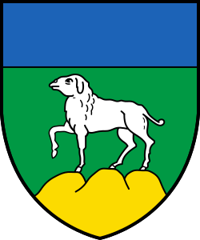
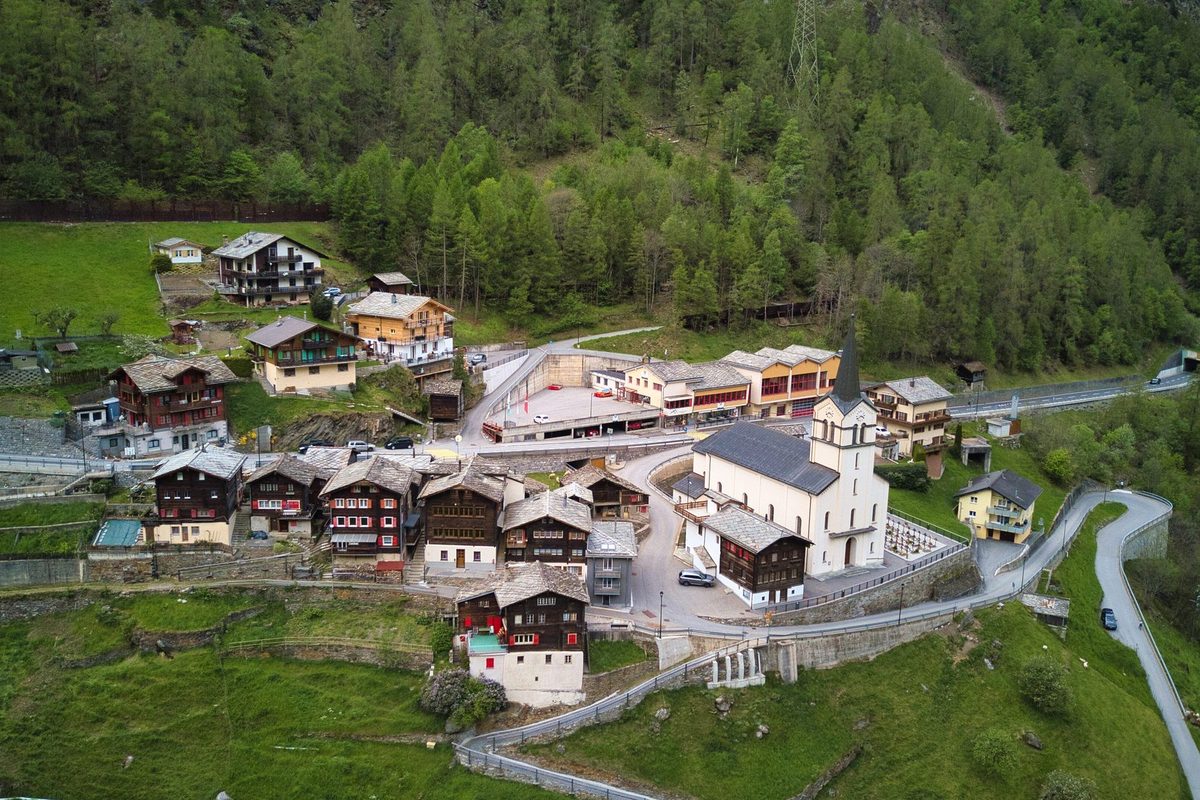
Eisten
Origin of the name Eisten
The place appears in 1299 as « Oysten ». The origin of the name has not been explained. In Upper Valais dialect it is reportedly « Eischtu ».[1]
Founding of Eisten
The municipality arose around 1455 from the grouping of several small economic units. Eisten spreads over the eastern and western slopes of the gorge at the entrance to the Saas valley. Higher up the slope, the hamlets of Katzenlukren and Montwald were still inhabited in the Middle Ages. The village then belonged to the quarter (Viertel) of Saas in the Visp dizain, and around 1300 the Blandrate family held important rights there. Communal rules governed collective life: regulation of the Mattwald alpine pasture (1396), boundary with Grächen (1498) and a communal organisation called the Bauernzunft (1583). Attached at first to the parish of Stalden, Eisten became a separate parish in 1892. The economy remained mainly agricultural. An early tourism was run for a time.[1]
History of Eisten
1299. Recorded as « Oysten ».[1]
around 1300. The Blandrate family holds important rights in Eisten.[1]
1396. Regulation of the Mattwald alpine pasture.[1]
around 1455. The municipality is formed by grouping several small economic units.[1]
1498. Boundary drawn with Grächen.[1]
16th century. Plague ravages the village.[1]
1583. A communal organisation (Bauernzunft) is adopted.[1]
1668. A chapel is mentioned.[1]
1818-1838. Eisten shares a rector with Staldenried.[1]
1857-1919. The Hutegge hotel is in operation.[1]
1891. The rectorate is limited to Eisten.[1]
1892. Eisten becomes a separate parish, detached from Stalden.[1]
1893-1895. The church is built.[1]
1932-1934. The mule track to the Saas valley is widened into the present road.[1]
2000. More than two thirds of the working population work outside the municipality.[1]
Population of Eisten
Sources and references: [1][3]
| 1798 | 107 inhabitants |
| 1850 | 177 inhabitants |
| 1900 | 250 inhabitants |
| 1950 | 400 inhabitants |
| 1960 | 454 inhabitants |
| 1970 | 330 inhabitants |
| 2000 | 226 inhabitants |
| 2025 | 189 inhabitants |
Historic sites in Eisten
Parish church. The church was built in 1893-1895, just after Eisten became a separate parish. The mountain guide Alexander Burgener (1845-1910) came from Eisten. The church and presbytery reportedly stand in the hamlet of Zen-Schmieden, the centre of the municipality, with the guide's grave nearby.[1][2]
Mattwald alpine pasture. Alpine pasture whose regulation of 1396 is among Eisten's oldest communal rules.[1]
Saas valley road. Former mule track linking the village with the Saas valley, widened in 1932-1934 into the present road.[1]
Remains in Eisten
Lost hamlets of Katzenlukren and Montwald. Hamlets higher up the slope, still inhabited in the Middle Ages and later abandoned.[1]
Sources
- Dictionnaire historique de la Suisse, « Eisten » (Philipp Kalbermatter, trad. Laurent Droz, version du 14.11.2005)
- Dictionnaire historique de la Suisse, « Burgener, Alexander » (Bernard Truffer, version du 20.11.2013)
- Office fédéral de la statistique (OFS), STATPOP, chiffres provisoires au 31.12.2025, via citypopulation.de
- geo.admin.ch, recherche de lieux (coordonnées)
Other villages near Eisten
Missing information, or do you have a source? Suggest a correction or addition. Every submission is checked before it's published.
Suggest a change