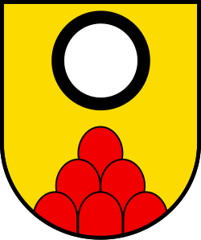
Saignelégier
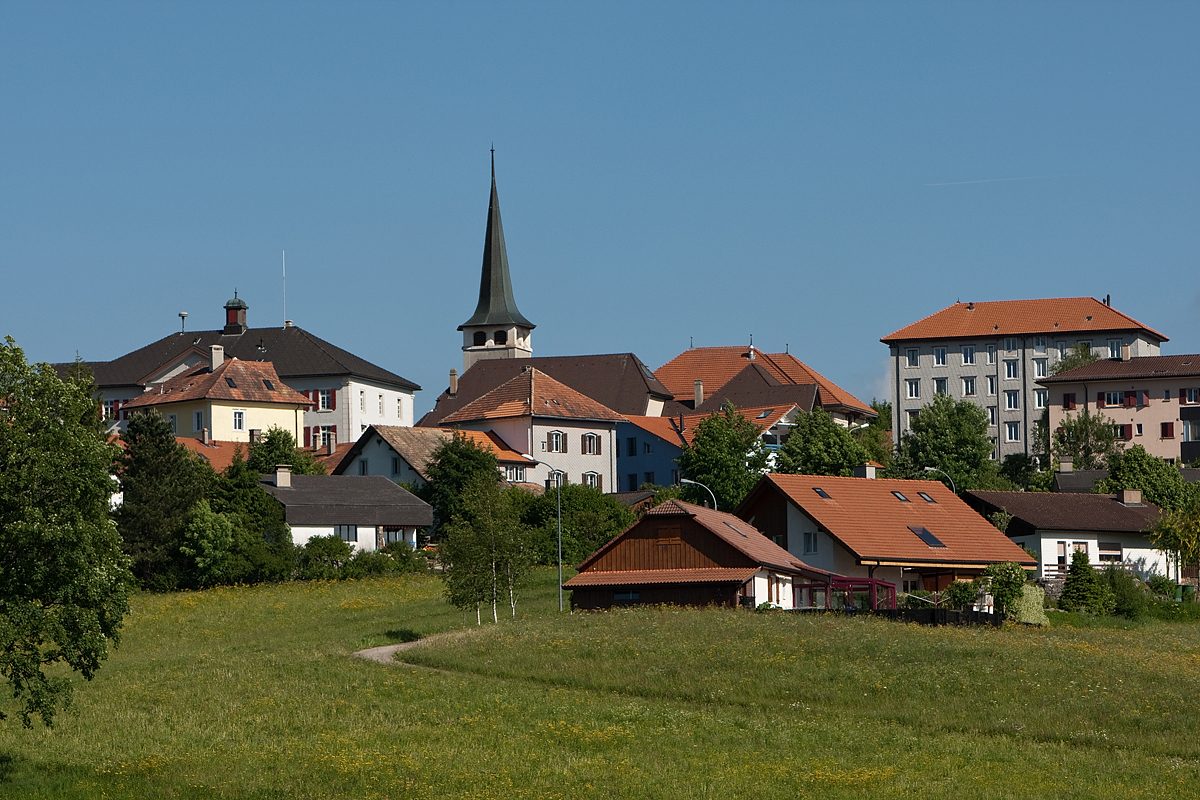
Origin of the name Saignelégier
The village appears in 1294 as « Saignelegier ». The forms « Sonnelegilier » (1382) and « Saigneligier » (1454) are reportedly also found. The name is said to mean « Légier's marsh », from « sagne » (marsh, marsh grasses) and a personal name, Légier or Léger. The old German name « Sankt Leodegar » reportedly comes from confusing the first element with « saint ». In the local patois the place is said to be called « Sèneleudjî ».[1]
Founding of Saignelégier
Neither the founder of the village nor the date of its creation is known; it appears in 1294. Saignelégier grew up on the Franches-Montagnes plateau, at a crossroads of routes towards Delémont, Tramelan, La Chaux-de-Fonds and France via Goumois. In the Middle Ages it belonged to the lands of the Bishopric of Basel. It gained importance in the 15th century, with a chapel and fairs, then became the residence of the priest of Montfaucon, the mother parish of the Franches-Montagnes, before being made a parish itself in 1629. Seat of the bailiff of the Franches-Montagnes from 1691, it has remained the administrative centre of the region. The present municipality, formed by the merger of 1 January 2009 with Goumois and Les Pommerats, stretches from the Doubs to the Étang de la Gruère.[1]
History of Saignelégier
1294. First mention: « Saignelegier ».[1]
Middle Ages. Saignelégier belongs to the lands of the Bishopric of Basel.[1]
1428. Start of the Saignelégier fairs. In the 15th century the village grows around a chapel.[1]
Before 1629. The priest of Montfaucon, the mother parish of the Franches-Montagnes, lives in Saignelégier.
1629. Saignelégier is made a parish, which also includes Le Bémont and Muriaux.[1][2]
1691. Saignelégier becomes the seat of the bailiff of the Franches-Montagnes and Saint-Ursanne. The bailiwick building dates from the late 17th century.[1]
1793-1813. Under French rule, Saignelégier is the chief town of a canton in the department of Mont-Terrible, then Haut-Rhin.[1]
1815. Joined to the canton of Bern. Saignelégier becomes the seat of the Franches-Montagnes prefecture, housed in the former castellany building.[1]
1851. Foundation of the Saint-Joseph hospital and hospice, rebuilt in 1864 and 1881.[1]
19th century. Watchmaking takes root; around the middle of the century Saignelégier becomes a mixed municipality.[1]
1878. Opening of the secondary school.[1]
1892. Opening of the Saignelégier-La Chaux-de-Fonds railway line.[1]
1897. First Marché-Concours national de chevaux.[1]
1898. The regional newspaper « Le Franc-Montagnard » is printed in Saignelégier.[1]
1904. Opening of the Saignelégier-Glovelier railway line.[1]
1913. Inauguration of the Protestant church.[1]
1927-1928. Rebuilding of the church of Notre-Dame-de-l'Assomption in neo-Baroque style.[1][2]
1979. Saignelégier, now in the canton of Jura, receives two cantonal departments.[1]
1985. Opening of the Centre de loisirs des Franches-Montagnes.[1]
1992. Creation of the Centre Nature Les Cerlatez.[1]
2003. The hospital becomes one of the four sites of the Hôpital du Jura.[1]
2009. On 1 January, Saignelégier merges with Goumois and Les Pommerats.[1]
Population of Saignelégier
Sources and references: [1]
| 1770 | 507 |
| 1818 | 536 |
| 1850 | 754 |
| 1870 | 1'012 |
| 1900 | 1'410 |
| 1950 | 1'489 |
| 2000 | 2'145 |
| 2009 | 2'527 (municipality merged with Goumois and Les Pommerats) |
| 2010 | 2'468 |
| 2020 | 2'585 |
| 2025 | 2'528 |
Historic sites in Saignelégier
Church of Notre-Dame-de-l'Assomption. Parish church rebuilt in 1927-1928 in neo-Baroque style and consecrated on 14 October 1928. A cultural property of regional importance. In 1798 the parish had acquired parts of the high altar carved by Antoine Monnot for the abbey church of Bellelay. A new organ was inaugurated in 1958. Its present configuration, dating from 2009, reportedly has 56 stops.[2][4]
Former bailiwick building (prefecture). Building from the late 17th century, seat of the bailiff of the Franches-Montagnes and Saint-Ursanne from 1691, then of the Bernese prefecture of the Franches-Montagnes from 1815 to 1978. A cultural property of regional importance (châtellenie). A prison tower reportedly adjoins it.[1][4]
Marché-Concours national de chevaux. Held since 1897, the Marché-Concours brings several tens of thousands of people to Saignelégier every year. Its hall is a cultural property of regional importance.[1][3][4]
Protestant church. Church inaugurated in 1913.[1]
Étang de la Gruère and Étang des Royes. Nature reserves within the municipality. The Centre Nature Les Cerlatez, opened in 1992, is devoted to discovering them.[1]
Sources
- Dictionnaire historique de la Suisse, « Saignelégier » (François Kohler), version du 11.12.2020
- Denis Moine, Chronologie jurassienne, « Saignelégier : Église catholique »
- Marché-Concours national de chevaux, Saignelégier, prospectus 2013 (document publié sur le site du canton des Grisons, hôte d'honneur)
- Office fédéral de la protection de la population (OFPP), Inventaire PBC, liste cantonale du canton du Jura (état au 1.1.2026)
- Statistique Jura, tableau JU-T.01.01.03, population résidante permanente au 31 décembre 2025
- geo.admin.ch (swisstopo), recherche de lieux « Saignelégier »
Localities of the municipality with a page
Other villages near Saignelégier
Missing information, or do you have a source? Suggest a correction or addition. Every submission is checked before it's published.
Suggest a change