Ermitage de Saint-Ursanne
Origin of the name Ermitage de Saint-Ursanne
The site is named after the hermit Ursicinus (Ursanne), a monk who died around 610-620 and who, according to tradition, withdrew to this cave. The name hermitage of Saint-Ursanne only came into use later.[1][2][3]
Founding of Ermitage de Saint-Ursanne
According to a tradition that arose long after the events, the hermit Ursicinus (Ursanne), a disciple of Saint Columbanus, chose as his retreat a cave hollowed out of a sheer rock face west of the castle ruins, above the Doubs. This cave and a small chapel lower down are said to lie at the origin of the town of Saint-Ursanne. For a long time they drew many pilgrims. The present layout, Stations of the Cross climbing the cliff with two chapels and the cave, dates from the 17th century, with additions from the 19th century. The site belongs to the former municipality of Saint-Ursanne, which became part of Clos du Doubs on 1 January 2009.[1][2][3]
History of Ermitage de Saint-Ursanne
Around 610-620. Death of the hermit Ursicinus (Ursanne), who according to tradition lived in the cave. His tomb is venerated in the collegiate church of Saint-Ursanne.[1][2][3]
7th century. The cult of Saint Ursanne is attested in the Jura from the last third of the century.[1]
17th century. Layout of the hermitage: Stations of the Cross climbing the cliff, two chapels and the cave.[3]
1621. Construction or rebuilding of the post-Gothic chapel next to the cave (date uncertain).[7]
19th century. New additions to the hermitage.[3]
1998. On 7 September, the Ermitage de Saint-Ursanne is listed as a protected historic monument.[4]
2010. The Federal Inventory of Swiss Heritage Sites (ISOS) records the hermitage in its survey of Saint-Ursanne.[3]
2020. Close of the jubilee year marking 1400 years since the death of Saint Ursanne.[6]
Historic sites in Ermitage de Saint-Ursanne
Cave of Saint Ursanne. Closed cave in the cliff, its entrance marked by a cross. It holds a statue of the hermit lying down, watched over by a statue of a bear.[3][5][6]
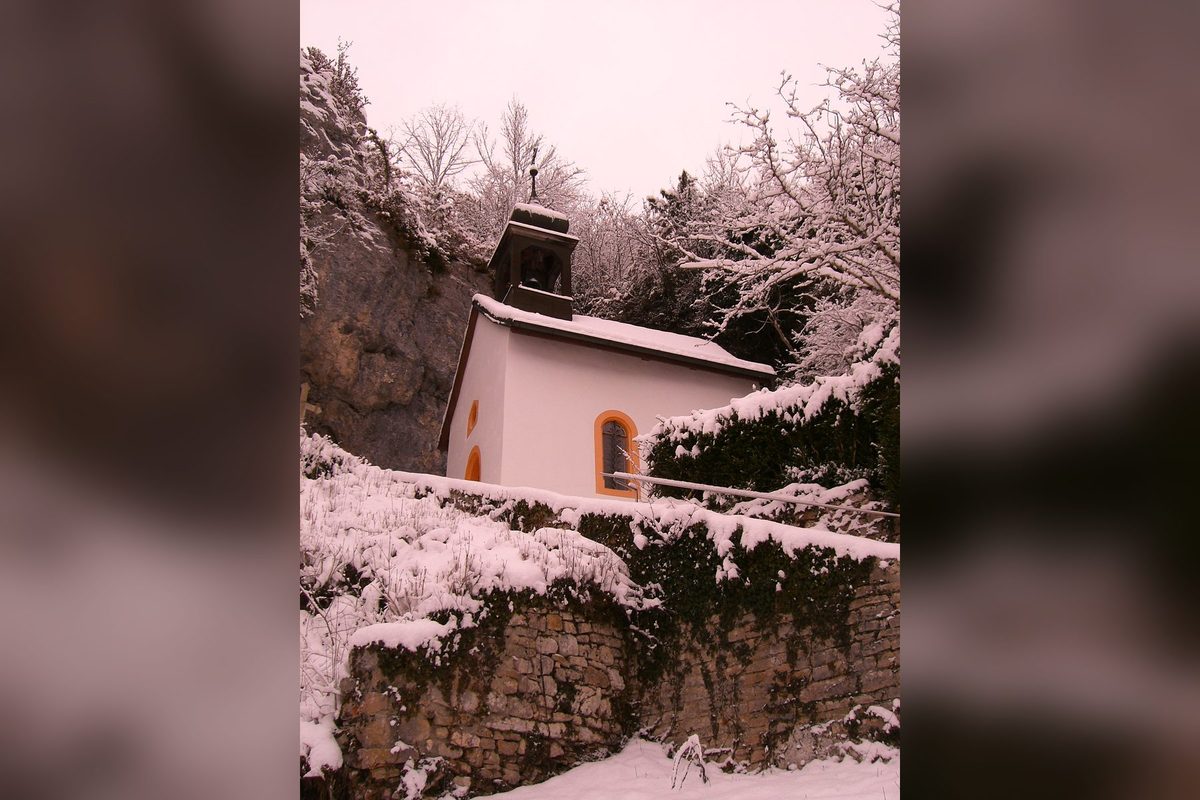
Hermitage chapel. Post-Gothic chapel next to the cave, rebuilt about 400 years ago, perhaps in 1621 (date uncertain).[5][7]
Stations of the Cross and staircase. From the Porte Saint-Paul, a lane and then a stone staircase of about 190 to 200 steps, north of the collegiate church, lead to the hermitage along a path of stations. A passage cut into the rock leads to a viewpoint over the Doubs valley.[3][4][5][6][7][8]
Legends of Ermitage de Saint-Ursanne
The hermit in his cave. According to tradition, the Irish monk Ursanne, a companion of Saint Columbanus, lived as a hermit in this cave above the Doubs. Shepherds and hunters are said to have settled near him, and the town grew up around his hermitage.[1][5][7][8]
Saint Ursanne's bear. According to legend, a bear ate the donkey that helped Saint Ursanne with his daily tasks. The saint then asked the bear to take the donkey's place. A statue of a bear watches over that of the hermit in the cave.[6]
Sources
- Dictionnaire historique de la Suisse, « Ursanne (saint) » (Romain Jurot), version du 15.09.2011
- Dictionnaire historique de la Suisse, « Saint-Ursanne (village) » (Jean-Paul Prongué), version du 18.05.2020
- Inventaire fédéral des sites construits (ISOS), « Saint-Ursanne », relevé 2010
- Denis Moine, Chronologie jurassienne, « Saint-Ursanne, Ermitage »
- Parc naturel régional du Doubs, « Ermitage de Saint-Ursanne »
- Amandine Beffa, « La grotte de l'Ermitage de Saint-Ursanne, Jura », L'Essentiel, 14.11.2020
- Romandie Tourisme, « Ville de Saint-Ursanne »
- Le Routard, « Saint-Ursanne »
Other villages near Ermitage de Saint-Ursanne
Missing information, or do you have a source? Suggest a correction or addition. Every submission is checked before it's published.
Suggest a change