Saint-Ursanne
Origin of the name Saint-Ursanne
The name appears in 1139 as « Sancti Ursicini ». It comes from the hermit Ursicinus (Ursanne), over whose tomb the religious centre grew up. In German the town was once called St. Ursitz.[1]
Founding of Saint-Ursanne
The town grew from the tomb of the hermit Ursicinus, who died around 610. Tradition makes him a companion of Saint Columbanus, which is not certain. A monastery grew up over his tomb, then the place became a regional religious centre and, before 1210, the seat of the provostry of Saint-Ursanne, which covered the Clos du Doubs. The small town formed on the right bank of the Doubs, around the collegiate church built between the 12th and 15th centuries, and stayed subject to the chapter. Walled in the 14th century, it never obtained real franchises. It was the wine tax granted by the Bishop of Basel to pay for the fortifications that made it a true town, run by a council and a burgomaster under the supervision of the episcopal bailiff.[1]
History of Saint-Ursanne
Mesolithic-Bronze Age. Human presence attested by finds at the site of Les Grippons.[1]
Around 610. Death of the hermit Ursicinus, around 610 or in 620. The religious centre develops over his tomb.[1][2]
849. A charter of Emperor Lothair (25 August) mentions the cella of Saint-Ursanne, the first written mention of the monastery.[3]
1139. Mention as « Sancti Ursicini ».[1]
1210. The Bishop of Basel, Lütold of Röteln, recognises the privileges of the provostry of Saint-Ursanne.[3]
Early 13th century. An annual fair is held in Saint-Ursanne.[1]
Around 1330. An episcopal fortress is built on the rock above the town.[1]
1356. The Basel earthquake reportedly damages the town and the bell tower of the collegiate church.
1376-1426. The provostry is pledged in turn to Jean de Vienne, the city of Basel and the lords of Neuchâtel in Burgundy. The town keeps the rights acquired during this period.[1]
1378. The Bishop of Basel grants a wine tax to fund the fortifications: Saint-Ursanne becomes a true town.[1]
15th century. Two annual fairs; the growing power of the prince-bishops halts the emancipation of the burghers.[1]
1618-1648. The Thirty Years' War ruins the town.[1]
1728-1729. Construction of the four-arched stone bridge over the Doubs.
1793. The chapter is abolished; Saint-Ursanne loses its role as seat of the provostry.[1][2]
1793-1814. The town belongs to the department of Mont-Terrible (1793-1800), then Haut-Rhin (1800-1814).[1]
1803. The former collegiate church becomes the parish church.[1]
1815-1978. Saint-Ursanne is part of the canton of Bern, in the bailiwick and later district of Porrentruy.[1]
1831. The town rejects the new Bernese constitution in protest at the refusal to create a district of Saint-Ursanne within the bounds of the old provostry.[1]
1861. Closure of the Bellefontaine ironworks.[1]
1876. The Saint-Ursanne-Courgenay railway tunnel is built. Metalworking and lime kilns follow.[1]
1977. On 3 February the Constituent Assembly, meeting in Saint-Ursanne, accepts the draft Constitution of the Republic and Canton of Jura.[3]
1986. The town is listed in the Inventory of Swiss heritage sites.[1]
1993. Closure of the lime kilns.[1]
2009. On 1 January Saint-Ursanne merges with Epauvillers, Epiquerez, Montenol, Montmelon, Ocourt and Seleute into the municipality of Clos du Doubs.[1]
2023. On 19 October the World Tourism Organization names Saint-Ursanne, together with Morcote, among the « Best Tourism Villages ».[9]
Population of Saint-Ursanne
Sources and references: [1]
| 1797 | 666 |
| 1850 | 726 |
| 1900 | 828 |
| 1950 | 1'277 |
| 2000 | 769 |
| 2008 | 688 |
Historic sites in Saint-Ursanne
Collegiate church. Romanesque church around which the town grew: choir, apse and crypt built between the last quarter of the 12th century and 1210, nave around 1200, vaults from 1259 to 1307, alterations in the 14th century. Its south portal, from the late 12th century, is the most important Romanesque portal in Burgundian style in Switzerland. The chapter's church until 1793, it became the parish church in 1803. With the cloister and the former church of Saint-Pierre, a cultural property of national importance.[2][5]
Cloister. Cloister rebuilt around 1380, with paired pointed arcades, most of them trefoiled, beneath which remains from the 7th-10th centuries have been found.[1]
Hermitage of Saint-Ursanne. Chapel clinging to the cliff beside the cave where, by tradition, the hermit lived. It is reached by a stairway of about 190 steps. Entered in the catalogue of protected monuments in 1998, it is a cultural property of regional importance. Its furnishings are said to date from the 17th and 18th centuries.[4][5]
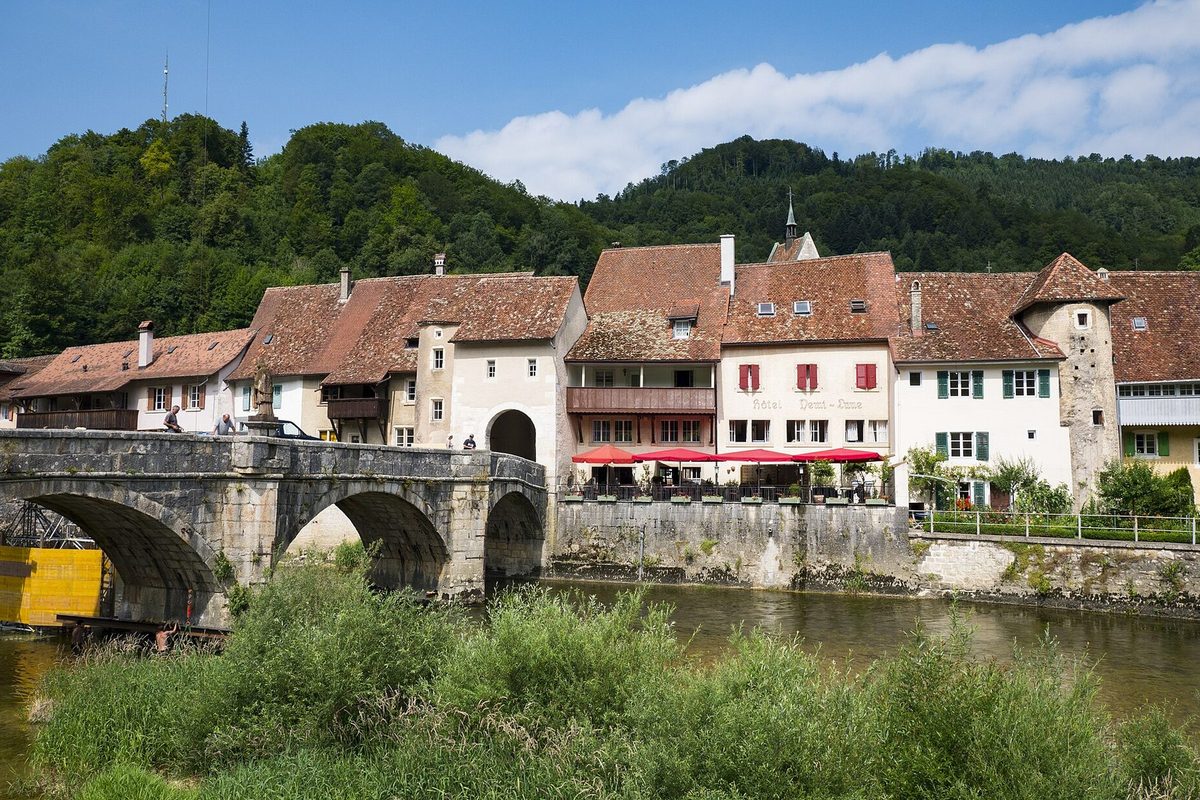
Saint-Jean bridge. Four-arched stone bridge built in 1728-1729 by the master mason Brunet to plans by the lawyer Humbert, replacing a wooden bridge of the 1670s. A cultural property of national importance. The statue of Saint John of Nepomuk (1731), a gift of Jean Münch de Münchenstein, is a 1973 copy. The original is in the Musée lapidaire.[5][10]
Town gates. The three town gates survive: Saint-Pierre to the east (small bell tower probably of 1665), Saint-Paul to the west (probably rebuilt in 1664) and Saint-Jean to the south, towards the bridge. With the town wall and the defence tower, the gates form a cultural property of national importance.[5][10]
Old town. Medieval centre with many late Gothic buildings, including former canons' houses, the town hall and a fountain bearing a statue of Saint Ursanne. The site has been in the inventory of protected sites since 1986. The medieval town is a cultural property of national importance.[1][5][10]
Remains in Saint-Ursanne
Castle ruins. Episcopal fortress built around 1330 on the rock north of the town. Its ruins are a cultural property of regional importance. A gate, a tower and stretches of wall are said to remain. Its stones were reused as building material, the last in 1828 for a spinning mill, a detail that is uncertain.[1][5]
14th-century town walls. Walls built in the 14th century and funded from 1378 by the wine tax. The rear façades of the houses form substantial remains of them, with a defence tower on the Doubs side (rue Basse 6). Part of them is said to have been restored.[1]
Early remains. Finds from the Mesolithic to the Bronze Age at Les Grippons and remains from the 7th-10th centuries beneath the cloister.[1]
Legends of Saint-Ursanne
The hermit Ursanne. According to legend, the town owes its origin to the Irish monk Ursanne (Ursicinus), who lived as a hermit in a cave above the Doubs. The Hermitage chapel was built in his honour beside this cave.[10]
Sources
- Dizionario storico della Svizzera, « Saint-Ursanne (villaggio) » (Jean-Paul Prongué), versione del 18.05.2020
- Dictionnaire historique de la Suisse, « Saint-Ursanne (chapitre) » (Jean-Paul Prongué), version du 11.06.2020
- Denis Moine, Chronologie jurassienne, « Saint-Ursanne : Histoire, Chronologie »
- Denis Moine, Chronologie jurassienne, « Saint-Ursanne : Ermitage »
- Office fédéral de la protection de la population (OFPP), Inventaire PBC, liste cantonale du canton du Jura (état au 1.1.2026)
- Inventaire PBC, fiche 3607 « Collégiale, cloître et ancienne église St-Pierre », texte de la Société d'histoire de l'art en Suisse (Guide artistique de la Suisse)
- Inventaire PBC, fiche 3614 « Pont sur le Doubs », texte de la Société d'histoire de l'art en Suisse
- Inventaire PBC, fiche 9586 « St-Ursanne, ville médiévale », texte de la Société d'histoire de l'art en Suisse
- Conseil fédéral, communiqué « Morcote und Saint-Ursanne von der UNWTO als « Beste Tourismusdörfer » ausgezeichnet » (19.10.2023)
- Suisse Tourisme (MySwitzerland), « St-Ursanne / Clos du Doubs »
- geo.admin.ch (swisstopo), recherche de lieux « St-Ursanne »
Other villages near Saint-Ursanne
Missing information, or do you have a source? Suggest a correction or addition. Every submission is checked before it's published.
Suggest a change