Vallorbe
Well over a thousand workers, mostly Italian, dug the Mont-d'Or tunnel, opened in 1915 together with the border station that made Vallorbe a major crossing into France.
Entry based on 15 sources · Our method · Reusable text (CC BY-SA)
Origin of the name Vallorbe
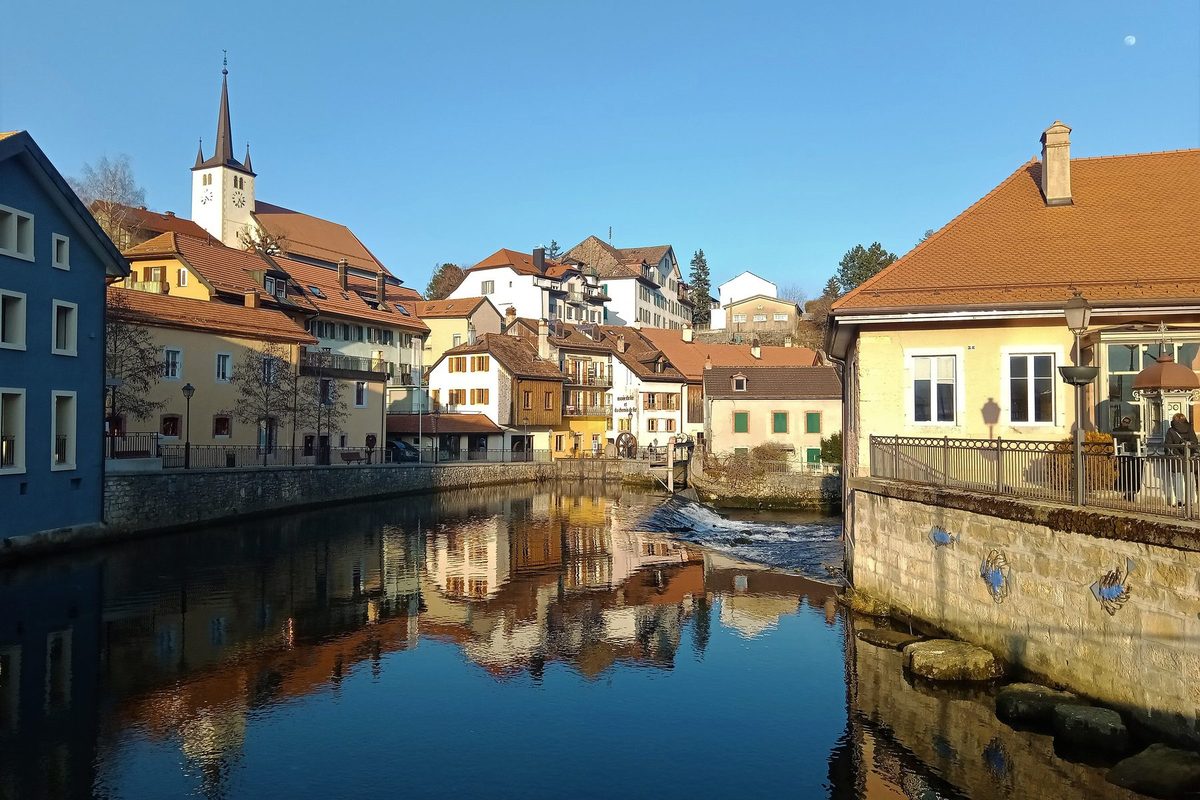
The name appears in 1139, in a bull of Pope Innocent II addressed to the prior of Romainmôtier, in the form «de valle urbanensi» («obedientiam de valle urbanensi cum capella»), then in 1148 as «de valle urbe». «Valorbes» follows at the beginning of the 13th century and «Vallorbes» from the late 15th century until around 1900. The final «s» disappeared from official use from October 1884. The name means «valley of the Orbe», the river that flows through the locality. The Orbe's own name is said to come from the Latin «orba», «dark river», alluding to its partly underground course.[1][2]
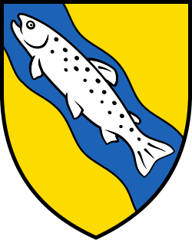
Coat of arms of Vallorbe
Or, on a bend wavy azure a trout proper. On a yellow field, a wavy blue band runs diagonally from top left to bottom right. It carries a trout in its natural colours.[13]
Founding of Vallorbe
No permanent settlement is proven before the 12th century. A few older isolated objects have reportedly been found: a Neolithic axe, a Celtic axe, a Roman coin. Lying away from the road over the Col de Jougne, the valley remained uninhabited until the Middle Ages. It belonged to the Cluniac monastery of Romainmôtier, from which the first settlers came, and the monks are said to have cleared it around 1100. An obedience of Romainmôtier with a chapel, seat of a small priory, is then mentioned there. The first inhabitants settled around the fountain of Saint-Pancrace, named after the patron saint of the church. The village then grew thanks to the water power of the Orbe, which very early attracted mills, sawmills and forges.[1][2][3]
History of Vallorbe
1139. First mention («de valle urbanensi») in a bull of Pope Innocent II confirming to the prior of Romainmôtier the obedience of the Orbe valley with its chapel.[1][2][3]
1148. The bishop of Lausanne hands over the church of Saint-Pancrace to Romainmôtier. The chapel is henceforth described as a church.[1][2][3]
13th century. Vallorbe reportedly comes under the influence of the Counts of Savoy while remaining under the direct authority of the priory of Romainmôtier, represented locally by a mayor and a mestral.
around 1285. At the instigation of the abbot of Romainmôtier, a sawmill and a first ironworks (La Dernier) are built near the source of the Orbe: the beginning of metalworking in Vallorbe.[1][3]
1322. The priory of Vallorbe, too poor for its prior to reside there, is incorporated into the mother house of Romainmôtier.[1]
first half of the 14th century. The population, numbering about 500 people, is decimated by the plague.[1][3]
1403. The prior of Romainmôtier Jean de Seyssel reportedly exempts the inhabitants from the «taille à miséricorde», replaced by a fixed due of twenty pounds.
1475. During the Burgundian Wars, the village is plundered by Confederate troops. Only 20 families remain in the village.[1][3]
late 15th century. Birth of the Grandes Forges quarter, in 1495. In 1499 the village has a sawmill, a tannery, two mills, two ironworks and a trip-hammer forge.[1][3][4]
1528. Construction of the first of three new blast furnaces. The last one is shut down around 1697, after which iron comes from Franche-Comté. Between 1600 and 1800 more than fifty small forges settle around the large works, making tools, then nails and files.[1][3]
1536. Bernese conquest of the Pays de Vaud. Vallorbe adopts the Reformation and its parish is retained.
1543. Vallorbe is placed under the Bernese bailiwick of Romainmôtier and becomes the seat of the castellany.[1][3]
1636-1638. Vallorbe takes in refugees from Franche-Comté.[1]
1710. The village has 108 nailsmiths.[1]
1712. Rebuilding of the temple, the former priory church of Saint-Pancrace. The parsonage dates from 1753.[1][3]
1713. A Council of Twelve and a Council of Twenty-Four replace the assembly that had governed the community until then.[1][3]
1798-1803. In 1798 several inhabitants join the pro-Bernese Légion fidèle; 76% of the working population then live from industry and crafts, 20% from agriculture. Under the Helvetic Republic Vallorbe belongs to the canton of Léman, then to the canton of Vaud. It is part of the district of Orbe from 1798 until the new districts came into force on 1 January 2008 and becomes the chief town of a circle in 1803.[1][3][11]
1870. Opening of the Vallorbe-Daillens line (with the Day viaduct) and of the first station.[1][3]
1871. Internment of soldiers of Bourbaki's army.[1]
1875. Opening of the international Pontarlier-Vallorbe line.[1][3]
1883. In April a fire destroys 98 houses and leaves about 700 people homeless.[3]
1886. Opening of the line from Le Day to Le Pont, linking Vallorbe to the Vallée de Joux.[3]
1889. A power station is said to have been commissioned at the Saut-du-Day.
1899. Founding of the Usines métallurgiques de Vallorbe, where file making is concentrated (branch in Saint Petersburg from 1902 to 1918).[1][3]
1915. Inauguration of the Mont-d'Or tunnel (Frasne-Vallorbe line) and of the new international station, on the Paris-Simplon axis. A good thousand workers, mostly Italians, were employed in building the tunnel, and many settled in Vallorbe.[1][3]
1937-1941. Construction of the Pré-Giroud artillery fort, intended to block the Jougne pass and access to the Mont-d'Or tunnel.[5]
1940-1945. The Mont-d'Or tunnel is blocked from 1940 to 1945. In 1945 Marshal Pétain surrenders to the French authorities at Vallorbe.[1]
1956-1972. Industrial decline: closure (at dates still to be checked) of the forges of Le Creux (1956), L'Éterpaz (1959), the Grandes Forges (1967) and the electrochemical plant at Le Day (1972).
1974. Opening to the public of the Orbe caves (Vallorbe caves).[1][3][8]
1980-1990. Opening of the Iron Museum (1980) in the Grandes Forges, then of the Railway Museum (1990). The Pré-Giroud fort is opened to the public in 1988.[1][3][4]
1984. Launch of the Paris-Lausanne TGV service via Vallorbe.[1][3]
1989. Vallorbe is connected to the A9b motorway.[1][3]
2002. Opening of the Juraparc.[1]
Population of Vallorbe
Sources and references: [1][3][7]
| first half of the 14th century | 500 people approximately, before the plague |
| 1397 | 55 to 60 heads of household (unconfirmed) |
| 1434-1437 | 28 heads of household (unconfirmed) |
| after 1475 | 20 families |
| 1499 | 16 heads of household (unconfirmed) |
| 1550 | 22 hearths (households) |
| 1703 | 925 |
| 1764 | 900 |
| 1850 | 1'491 |
| 1870 | 1'982 |
| 1900 | 3'279 |
| 1920 | 4'621 |
| 1941 | 3'592 (unconfirmed) |
| 1950 | 3'896 |
| 1960 | 3'990 (unconfirmed) |
| 1970 | 4'028 |
| 1980 | 3'375 (unconfirmed) |
| 1990 | 3'271 (unconfirmed) |
| 2000 | 3'247 |
| 2010 | 3'312 (or 3'293) |
| 2020 | 3'863 (unconfirmed) |
| 2025 | 4'434 |
Families of Vallorbe
Burgher families before 1800. Amey, Clément, Falcy, Fauconnet, Favre, Francfort, Glardon, Grobet, Grobéty, Jaillet, Jaquet, Matthey, Roy, Truan and Vallotton, with no precise date. The de Hennezel, from Yverdon VD, were registered in 1589. No family was registered in the 19th century.[15]
From 1901 to 1962. Forty-one entries, from 1919 to 1962. Thirty-two date from 1950 or later, nine of them from 1956 alone. Fourteen families came from the canton of Bern and twelve from other cantons. Ten came from abroad: five from Italy, four from France and one from Germany.[15]
Economy of Vallorbe, past and present
From nails to files. By the great fire of 1883, only a few nail workshops remained in Vallorbe. The town then chose the file, essential to mechanics and watchmaking.[14]
Lime, chlorates and plastics. After the railway arrived, activities diversified: power plants, a lime works for cement from 1870 to 1933, a chlorate factory, closed in 1972, and a factory for Bakelite and later plastics (1904). In 1905 the town had eight hotels. The crisis of the 1930s halted this growth a first time, and the shock of 1975 led to the closure of several firms. In 2005 the secondary sector still provided 47% of jobs.[1]
The border and tourism. Jobs linked to customs and transport declined. Vallorbe had 55 cross-border commuters in 1955, 731 in 1991 and 530 in 2012. In 1988 it was among the poor municipalities of the canton. It developed transit tourism around the caves, the iron and railway museums, the Pré-Giroud fort and the Juraparc. These attractions benefit from the A9b motorway, opened in 1989, and have secured the continued TGV stop.[1]
Historic sites in Vallorbe
Source of the Orbe and Vallorbe caves. The Orbe re-emerges at Vallorbe after an underground course from the lakes of the Vallée de Joux, a link demonstrated by scientific work between 1865 and 1893 (or around 1900, date uncertain). After a first dive in a diving suit in 1893, Geneva divers resumed exploration in 1961. In 1964 Christian Giurumello reportedly discovered the former open-air course of the Orbe. The caves were opened to the public in 1974, and the mineral exhibition of the «Trésor des fées» was added in 1992. In 2017 the network reportedly exceeded 30 kilometres of explored passages.[8][9]
Grandes Forges and Iron and Railway Museum. The metallurgical heart of Vallorbe since the late 15th century, the Grandes Forges quarter reportedly operated until 1967. Since 1980 it has housed the Iron Museum, where paddle wheels still drive the machinery of the old forges, complemented in 1990 by the Railway Museum, devoted in particular to the Simplon line.[3][4]
International station. Inaugurated in 1915 with the Mont-d'Or tunnel, the vast border station made Vallorbe a major Franco-Swiss crossing point. The Simplon-Orient-Express reportedly served it until 1977, followed by the TGV from 1984. It is listed as a cultural property of national importance.[1][3][10]
Pré-Giroud fort. Artillery fort built from 1937 to 1941 to block the Jougne pass, prevent use of the Mont-d'Or tunnel and support the defence of the border. Occupied throughout the mobilisation of 1939-1945, in 1988 it became the first Swiss fortification open to the public.[5]
Saint-Pancrace temple. Former priory church, mentioned as a church from 1148, rebuilt in 1712. The neighbouring parsonage dates from 1753.[1][3]
Day viaduct. Railway structure of the Vallorbe-Daillens line, dating from 1869. It was reportedly built from 1867 and re-vaulted in 1923-1925.[1]
Casino. Opened in 1908 and renovated in 2012, the casino, with its music and theatre hall, contributes together with the station, the Day viaduct and the dam to the urban character of Vallorbe.[1][3]
Remains in Vallorbe
Old forges and ironworks. The forges of Vallorbe were active from the 13th to the 20th century: La Dernier ironworks around 1285, Le Vivier ironworks from 1488, blast furnaces from 1528, then nail works and file factories in the 19th century. The Grandes Forges, preserved with their water wheels, are their main witness.[1][3]
Grotte aux Fées. Cave near Vallorbe where remains of cave bears were found. It is said to be the first site in the Vaud Jura to have yielded them.
Protected heritage in Vallorbe
Cultural property of national significance (A objects in the PCP inventory)[12]
- Gare internationale: bâtiments des voyageurs, des douanes suisse et française, portail du tunnel et zone de préparation et de manœuvres des locomotives à vapeur (fosse aux scories, quai à charbon, grue-à-eau et pont- tournant)
Cultural property of regional significance (B objects)[12]
- Ancienne fabrique d'aiguilles Universo S.A.
- Musée du fer et du chemin de fer
- Musée du Fort de Pré-Giroud
- Villa d'Henri Grobet
Legends of Vallorbe
The Grotte aux Fées and Donat the blacksmith. According to a tale published in 1938, Donat, a young 25-year-old blacksmith who mocked the fairies, entered the great cave at midnight. A fairy welcomed him and promised him a pearl and a diamond every day, on condition that he never entered a forbidden cave. Driven by curiosity, he disobeyed and discovered that the fairy had goose feet hidden under her long dress. Driven out, he returned to the village where his treasures turned into dead leaves. Mocked by all, he left the country, and since then the caves of Vallorbe have no longer been inhabited by fairies.[6]
The «Tire-Lune». The people of Vallorbe bear the nickname «Tire-Lune». Tradition offers several explanations: a tipsy hunter is said to have shot at the reflection of the moon in the Orbe. A simpleton is said to have aimed at the moon thinking he would hit a shooting star; or else marksmen of the municipality are said to have wanted to test the range of their carbines.
Sources
- Dictionnaire historique de la Suisse, « Vallorbe » (J.-P. Dépraz, version remaniée du 27.12.2014)
- Commune de Vallorbe, « Naissance du village »
- Inventaire fédéral ISOS, « Vallorbe »
- museums.ch, « Musée du fer et du chemin de fer »
- Association Fort de Litroz, « Le fort d'artillerie de Vallorbe / Pré-Giroud »
- « La légende de la Grotte aux Fées de Vallorbe », FAVJ du 12 mai 1938 (histoirevalleedejoux.ch)
- Statistique Vaud, « Population résidante permanente au 31 décembre 2025 »
- Showcaves.com, « Grottes de Vallorbe »
- museums.ch, « Grottes de Vallorbe »
- Office fédéral de la protection de la population, géodonnées de l'inventaire PBC, objet 6513 « Gare internationale » de Vallorbe (catégorie A)
- État de Vaud, communiqué du 12.07.2007, « Les préfètes et les préfets sont attribués aux nouveaux districts »
- Federal Office for Civil Protection (FOCP), Swiss Inventory of Cultural Property (PCP), list for the canton of Vaud (as of 1.1.2026)
- IPI, Swissreg, emblems database: coat of arms of Vallorbe (no. 101441)
- Municipality of Vallorbe, "Cité du fer"
- Register of Swiss Surnames, 3rd edition (1989), search Commune "Vallorbe", Canton VD
Published by Sébastien Jörg ·
Other villages near Vallorbe
Missing information, or do you have a source? Suggest a correction or addition. Every submission is checked before it's published.
Suggest a change